Species
African tigerfish
African tigerfish, tiervis in South Africa. A silver, black-striped characin with fangs that hits hard, jumps high and draws anglers to the Zambezi, Lake Kariba and the Okavango Delta.
Hydrocynus vittatus
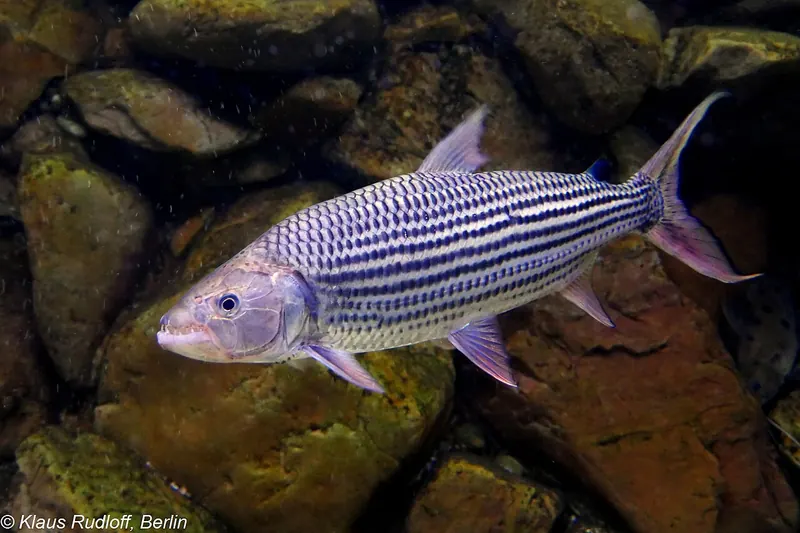
Photo: Klaus Rudloff, Wikimedia Commons, CC BY-SA 4.0, adjusted to 3:2
- Spawning
- Breeding habits are little known; spawning probably takes place over a few days in December or January, when rivers swell with the start of the rainy season. Eggs are laid in flooded vegetation in shallow water near the bank (Wikipedia). Matures on average at 39.8 cm (FishBase).
- Typical method
- Casting spoons, spinners and plugs in the current (rule of thumb)
- Top bait
- Spoon
How to recognise it
- Silver with thin black lengthwise stripes along the flanks
- Large conical fangs that overlap the jaws when the mouth is closed
- Red-tinged forked tail with a black edge, tip of the adipose fin black
Easily confused with: Hydrocynus forskahlii has a similarly large range but is slimmer, its dorsal fin sits further forward and it lacks the black tips on the tail and adipose fin (German Wikipedia). The Goliath tigerfish (Hydrocynus goliath) lives only in the Congo basin and Lake Tanganyika, grows much larger and has faint or no stripes (German Wikipedia).
How to catch it
Methods: Casting spoons, spinners and plugs in the current (rule of thumb), Drifting with fish strips or baitfish from a boat (rule of thumb), Trolling on big lakes such as Lake Kariba (rule of thumb), Fly fishing with large streamers (rule of thumb)
Baits: Spoon, Spinner, Shallow-running crankbait, Fish strip or baitfish (where allowed), Streamer
Tigerfish like warm water of 22 to 28 °C (FishBase), so the warm months are considered best (rule of thumb). A wire or titanium leader is a must because of the teeth (rule of thumb). Ask your operator about the best months for each venue.
Habitat and food
Widespread in Africa: in West Africa the Senegal, Volta, Niger, Benue and Lake Chad, plus the Congo basin, Nile, Omo, Zambezi, Limpopo, Rovuma, Shire, Rufiji and Ruaha, lakes Tanganyika, Rukwa, Albert and Kariba, the Okavango basin and coastal rivers south to the Pongola (FishBase). Prefers warm, well-oxygenated water of 22 to 28 °C in larger rivers and lakes (FishBase). Closer to the surface by day, near the bottom at night; migrates up to 100 km within a river (Wikipedia). Main destinations for anglers are Zimbabwe and Zambia (Zambezi, Lake Kariba), Botswana and Namibia (Okavango), Tanzania and South Africa (Jozini Dam).
From about 9 to 10 cm long it eats only fish, taking whatever is most abundant, favouring characins such as Brycinus and Micralestes, barbs and the Tanganyika sardine Limnothrissa (FishBase); juveniles also eat shrimp, insects and zooplankton (Wikipedia). At Schroda Dam in South Africa tigerfish were seen catching barn swallows in flight, with a success rate of about 25 percent (Wikipedia).
Size and age
FishBase: max. 105 cm fork length (males), females max. 74 cm, maximum published weight 28 kg, maximum age 8 years. Males grow larger and heavier-bodied than females (Wikipedia).
Protection and rules
Size limits, bag limits, seasons and licences are set by each country, in the USA by each state. Pescaday does not list these rules: check them with your operator and the national authority before you fish. Notes with sources are given above under conservation status. Fishing travel guide
In the kitchen
An important food and income fish for local people (Wikipedia). Sport anglers mostly release it (rule of thumb).
Sources (3)
- fishbase.se/summary/Hydrocynus-vittatus.html
- en.wikipedia.org/wiki/Hydrocynus_vittatus
- de.wikipedia.org/wiki/Tigersalmler
Last checked 2026-10-22. Found a mistake? Write to [email protected].
Know more?
Additions, photos of your catches or a mistake in the text: write to us and we will gladly credit you as a helper.
Send a tip