Species
Striped marlin
Striped marlin, the most abundant and widespread billfish of the Indo-Pacific, for anglers above all off Baja California, California and Hawaii: blue stripes that glow lavender when the fish is excited.
Kajikia audax
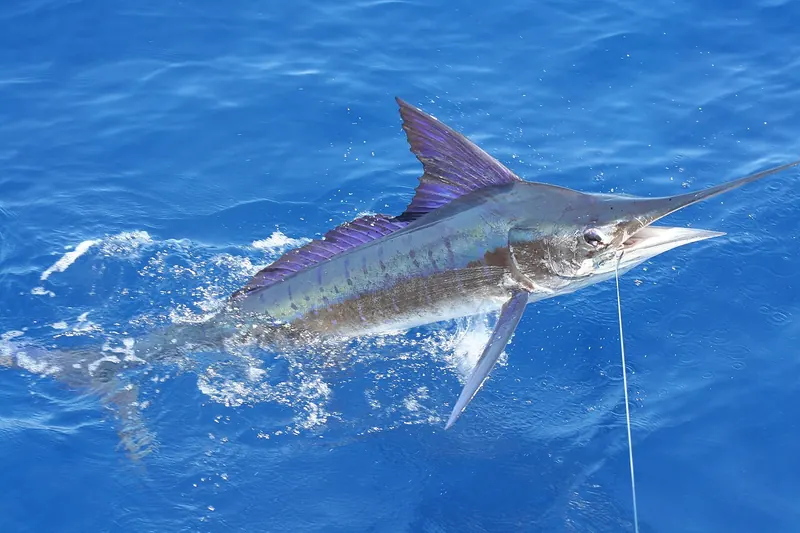
Photo: Jackiemora01, Wikimedia Commons, CC BY-SA 3.0, adjusted to 3:2
- Spawning
- In the local early summer (FishBase) or summer, with 4 to 41 spawning events per season and up to 120 million eggs per female (Wikipedia). Larvae only from about 24 °C; spawning grounds between 10° and 30° S in the southwest Pacific and 10° to 20° S in the northeastern Indian Ocean (FishBase). Mature at 1 to 2 years or 1.4 m (males) and 1.5 to 2.5 years or 1.8 m (females) (Wikipedia); FishBase gives a mean of 210 cm.
- Typical method
- Trolling lures over edges and banks
- Top bait
- Skirted trolling lure
How to recognise it
- First dorsal fin as tall as the body or taller, without dark spots (FishBase, Wikipedia)
- 12 to 20 distinct blue vertical stripes, still visible after death (Wikipedia)
- Pectoral fins sickle-shaped and flexible, not rigid (FishBase, German Wikipedia)
Easily confused with: Blue marlin: first dorsal fin lower than the body depth (German Wikipedia, Blue marlin). White marlin: Atlantic, dorsal fin spotted black, rounded pectorals (German Wikipedia, White marlin). Sailfish: sail-like dorsal fin much taller than the body.
How to catch it
Methods: Trolling lures over edges and banks, Pitching live bait to marlin seen at the surface (rule of thumb), Trolling teasers, then switching to a bait (bait and switch, rule of thumb), Fly fishing for teased fish (rule of thumb)
Baits: Skirted trolling lure, Live mackerel, Live sardine, Squid, Large streamer (fly)
According to one study it stays deeper by day and comes to the surface at night, observed off Australia, New Zealand, Mexico, California and Ecuador (Wikipedia); the same source also says it hunts by day in the top 100 m. Stocks follow warm water of roughly 20 to 26 °C (German Wikipedia); ask locally for the season in each area (rule of thumb).
Habitat and food
Tropical, subtropical and temperate Indo-Pacific, 0 to 200 m deep, at 20 to 25 °C (FishBase); Wikipedia gives 20 to 28 °C for the largest populations, German Wikipedia 20 to 26 °C. In the Pacific a horseshoe-shaped range from the northwest Pacific through the eastern Pacific to the southwest Pacific; in the Indian Ocean off East Africa, in the western Arabian Sea, the Bay of Bengal and off northwest Australia (FishBase). Lives in cooler water than blue and black marlin, close to shore only where the shelf drops off steeply (FishBase). Common around Hawaii (German Wikipedia); the eastern Pacific is considered especially favourable habitat (Wikipedia).
Fish, crustaceans and squid (FishBase), especially sardines, mackerel, small tunas and cephalopods; off Mexico it preferred chub mackerel, round herring and Pacific sardine as well as jumbo squid (Wikipedia).
Size and age
FishBase: max. 420 cm, commonly around 290 cm, maximum published weight 440 kg, maximum age 9 years. Wikipedia gives an average of 2.9 m, a maximum of 4.2 m and up to 220 kg, and up to 10 years of life; German Wikipedia up to 4.4 m and 420 kg for females, males stay smaller. The weight figures clearly contradict each other.
Protection and rules
In the USA, each state sets its own size limits, bag limits and seasons. Pescaday does not list these rules yet: check them with the fish and wildlife agency of the state you fish in. Fishing licence USA: agency by state
In Germany we found no minimum size or closed season for this species in any state fisheries regulation.
In the kitchen
According to FishBase the best flesh of all billfishes for sashimi and sushi, mostly sold frozen, also smoked. Firm, light pink to orange-red, stronger than swordfish, usually grilled (Wikipedia). German Wikipedia points to mercury in the meat; sport anglers usually release it.
Sources (6)
- fishbase.se/summary/Kajikia-audax.html
- en.wikipedia.org/wiki/Striped_marlin
- de.wikipedia.org/wiki/Gestreifter_Marlin
- fisheries.noaa.gov/permit/pacific-highly-migratory-species-permits
- law.cornell.edu/regulations/california/14-CCR-28.50
- fisheries.noaa.gov/southeast/rules-regulations/fishing-regulations-and
Last checked 2026-10-22. Found a mistake? Write to [email protected].
Know more?
Additions, photos of your catches or a mistake in the text: write to us and we will gladly credit you as a helper.
Send a tip