Species
Striped bass
Striped bass, also called striper or rockfish: the classic East Coast inshore fish with seven to eight dark lengthwise stripes that runs up rivers to spawn and is caught in the surf, in bays and in big reservoirs.
Morone saxatilis
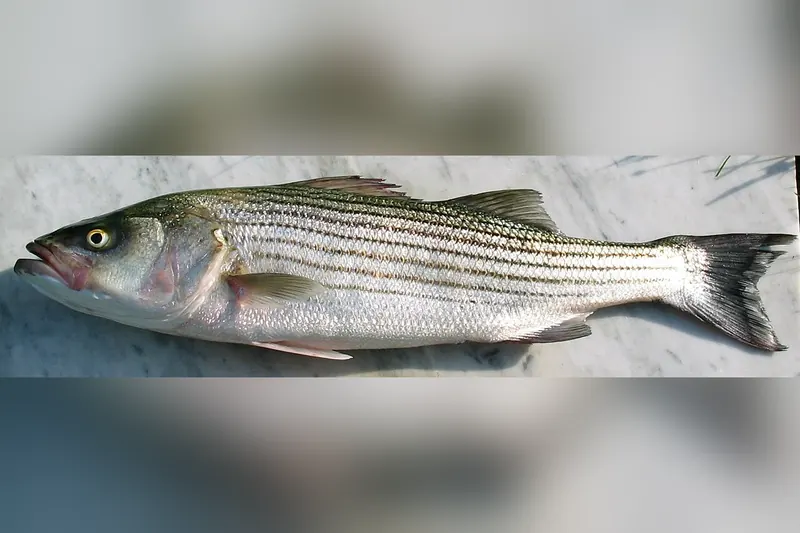
Photo: Tim Van Vliet, Wikimedia Commons, CC BY-SA 3.0, adjusted to 3:2
- Spawning
- Spring, in fresh or brackish river water; larvae drift down to the estuaries, where juveniles usually stay for 2 to 4 years (NOAA Fisheries). Males mature at 2 to 4 years, females at 4 to 8 years (NOAA Fisheries). Key spawning areas include Chesapeake Bay and the Hudson and Delaware rivers (English Wikipedia).
- Typical method
- Surf casting from the beach
- Top bait
- Live eel
How to recognise it
- Silvery, streamlined body with seven to eight narrow, dark, unbroken lengthwise stripes (German Wikipedia)
- Dark greenish back, white belly
- Two separate dorsal fins, the front one spiny
Easily confused with: The cross with the white bass (Morone chrysops), the hybrid striped bass (wiper), is more compact and deeper bodied, resembles the white bass and has broken rather than unbroken stripes; hybrids are stocked in many US fresh waters (German Wikipedia Streifenbarsch, English Wikipedia).
How to catch it
Methods: Surf casting from the beach, Trolling from a boat, Casting plugs, poppers and spoons, Drifting a live eel or baitfish
Baits: Live eel, Menhaden (bunker), live or as cut bait, Sandworms and bloodworms, Clams, Plugs and poppers
In spring spawners run up the rivers, and Chesapeake Bay fish migrate along the coast as far as Canadian waters (NOAA Fisheries). Spring and fall are the main coastal seasons, dawn, dusk and night often the best times (rule of thumb).
Habitat and food
Western Atlantic from the St. Lawrence River in Quebec to Lake Pontchartrain in Louisiana, and in Florida south to the St. Johns and Suwannee river drainages (FishBase). Anadromous: adults live in coastal waters and bays and run up rivers to spawn in spring; some populations are landlocked (FishBase, German Wikipedia). Introduced to the Pacific coast and many US reservoirs, now found on the West Coast from Mexico to British Columbia (English Wikipedia, NOAA Fisheries). FishBase gives a water temperature range of 8 to 25 °C.
Voracious and opportunistic: larvae eat zooplankton, juveniles small shrimp, crustaceans, worms and insects, adults mainly fish such as alewives, herring, smelt, eels, flounder, sand lance and silversides, plus squid and crabs. They stop feeding shortly before spawning (FishBase, German Wikipedia).
Size and age
FishBase: max. 200 cm, common around 120 cm, maximum published weight 57.0 kg, maximum age 30 years. According to English Wikipedia mature fish commonly weigh 20 to 40 lb (9 to 18 kg); the largest known fish weighed 124 lb (56 kg) and was netted in 1896. NOAA Fisheries gives up to 5 feet and 77 lb. IGFA all-tackle world record: 81 lb 14 oz (37.14 kg), 2011 in Long Island Sound off Connecticut, taken on a live eel (English Wikipedia). The sources differ on maximum weight.
Protection and rules
In the USA, each state sets its own size limits, bag limits and seasons. Pescaday does not list these rules yet: check them with the fish and wildlife agency of the state you fish in. Fishing licence USA: agency by state
In Germany we found no minimum size or closed season for this species in any state fisheries regulation.
In the kitchen
White, mild meat with a medium texture and a large flake; can be pan seared, grilled, steamed, poached and deep fried (English Wikipedia, FishBase). In Virginia a consumption advisory applies to fish from Chesapeake Bay because of PCBs (English Wikipedia): follow local advice.
Sources (6)
- fishbase.se/summary/Morone-saxatilis.html
- en.wikipedia.org/wiki/Striped_bass
- de.wikipedia.org/wiki/Morone_saxatilis
- de.wikipedia.org/wiki/Streifenbarsch
- fisheries.noaa.gov/species/atlantic-striped-bass
- asmfc.org/species/atlantic-striped-bass
Last checked 2026-10-22. Found a mistake? Write to [email protected].
Know more?
Additions, photos of your catches or a mistake in the text: write to us and we will gladly credit you as a helper.
Send a tip