Species
Spotted bass
The spotted bass, also called Kentucky spotted bass or spots, is the smaller cousin of largemouth and smallmouth: a black bass of flowing, rocky rivers and reservoirs in the southern US, known by rows of spots below the lateral line (Wikipedia).
Micropterus punctulatus
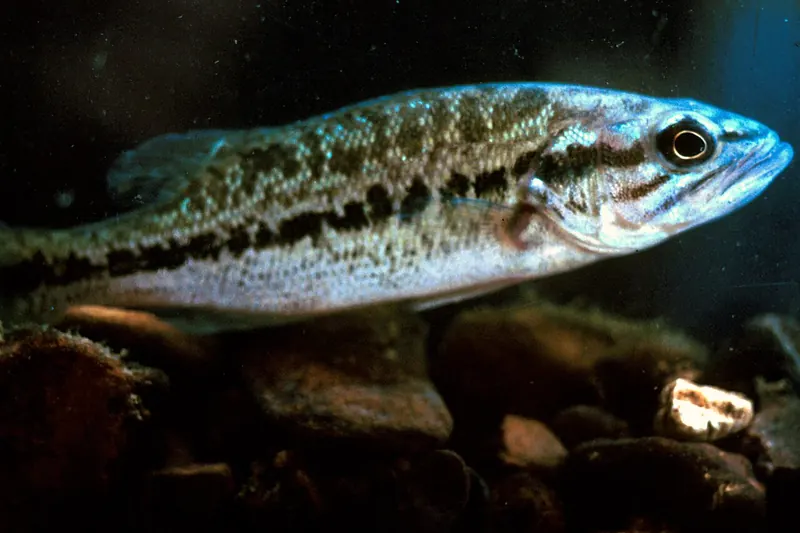
Photo: Dick Biggins, USFWS, Wikimedia Commons, Public domain, adjusted to 3:2
- Spawning
- April to May in habitat similar to smallmouth; the male builds a nest in gravel, attracts a female and guards the eggs until the fry disperse (Wikipedia).
- Typical method
- Casting small soft plastics on jig heads along rock and riprap (Wikipedia on habitat, rule of thumb)
- Top bait
- Small finesse worm or tube
How to recognise it
- Rows of small black spots below the lateral line, otherwise colored much like a largemouth (Wikipedia)
- Upper jaw does not extend past the rear edge of the eye, mouth smaller than a largemouth's (Wikipedia)
- First and second dorsal fins clearly connected, scales on the base of the second dorsal (Wikipedia)
Easily confused with: Largemouth bass: similar color, but a larger mouth with the upper jaw reaching past the eye and no scales on the base of the second dorsal (Wikipedia). Smallmouth bass: vertical bars and no spot rows below the lateral line; the two species hybridize (Wikipedia). Alabama bass (M. henshalli): recognized separately since 2010, native to the Coosa and Tallapoosa, much larger on average (Wikipedia).
How to catch it
Methods: Casting small soft plastics on jig heads along rock and riprap (Wikipedia on habitat, rule of thumb), Drop shot and finesse rigs on deep ledges, because it holds deeper than smallmouth (Wikipedia on depth, rule of thumb), Shallow crankbaits and spinnerbaits in flowing river stretches (rule of thumb), Fly fishing with streamers and crayfish patterns in creeks (rule of thumb)
Baits: Small finesse worm or tube, Jig with crayfish trailer, Shallow crankbait, Spinnerbait, Streamer (fly)
Before and after spawning in April and May fish hold shallower (Wikipedia on spawning, rule of thumb); in summer they also use depths down to 30 m in reservoirs (Wikipedia).
Habitat and food
Mississippi basin from southern Ohio and West Virginia to southeastern Kansas and south to the Gulf of Mexico, plus Gulf drainages from the Chattahoochee in Georgia to the Guadalupe River in Texas; introduced in southern Africa (FishBase). Lives in clear, gravelly pools and runs of creeks and small to medium rivers, also lakes and reservoirs (FishBase). Holds in more current than largemouth and in warmer, more turbid, slower water than smallmouth like; around vegetation, submerged logs, rock and riprap, down to 30 m (100 ft) (Wikipedia).
Mostly small fish, crayfish and aquatic insects; the young start with copepods and small crustaceans, then insects. It eats only about half as much fish as the largemouth (Wikipedia). FishBase also lists frogs, worms and grubs for adults.
Size and age
FishBase: max. 63.5 cm, commonly 30 cm, maximum published weight 4.7 kg, maximum age 7 years. According to Wikipedia almost 64 cm (25 in) and up to 5.2 kg (11 lb), age at least seven years (elsewhere about six). Record according to Wikipedia: 10.27 lb (4.66 kg) from Pine Flat Lake, California.
Protection and rules
In the USA, each state sets its own size limits, bag limits and seasons. Pescaday does not list these rules yet: check them with the fish and wildlife agency of the state you fish in. Fishing licence USA: agency by state
In Germany we found no minimum size or closed season for this species in any state fisheries regulation.
In the kitchen
A popular game fish and good eating (Wikipedia).
Sources (4)
- fishbase.de/summary/Micropterus-punctulatus.html
- en.wikipedia.org/wiki/Spotted_bass
- de.wikipedia.org/wiki/Sonnenbarsche
- tpwd.texas.gov/regulations/outdoor-annual/fishing/freshwater-fishing/b
Last checked 2026-10-22. Found a mistake? Write to [email protected].
Know more?
Additions, photos of your catches or a mistake in the text: write to us and we will gladly credit you as a helper.
Send a tip