Species
Sockeye salmon
The sockeye, red or blueback salmon is the most valuable Pacific salmon commercially: silvery blue at sea, bright red with a green head at spawning time; its landlocked form, the kokanee, lives its whole life in fresh water (English and German Wikipedia).
Oncorhynchus nerka
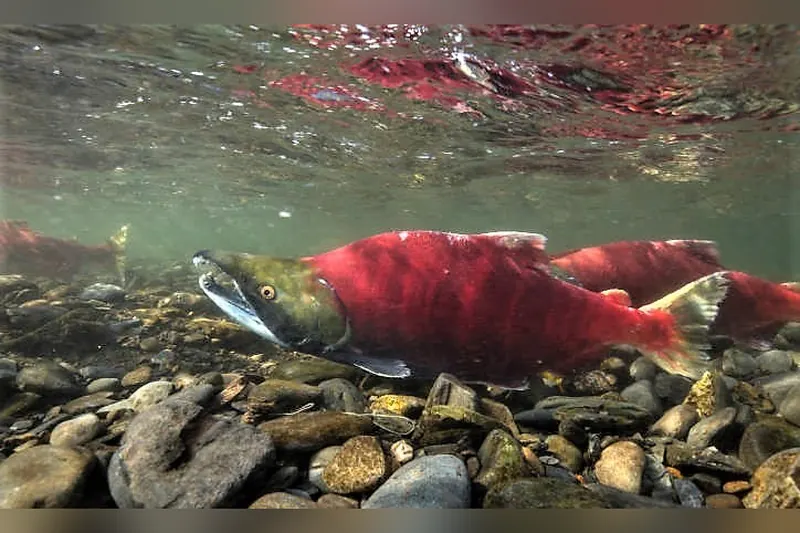
Photo: US Fish & Wildlife Service, Wikimedia Commons, Public domain, adjusted to 3:2
- Spawning
- In summer and fall, in the south of the range as late as December; a female needs 3 to 5 days for 3 to 5 nests, and all adults die after spawning (FishBase). Mostly spawns in rivers near lakes; eggs hatch after six to nine weeks, juveniles spend one to two years in the lake and then two to three years at sea (Wikipedia).
- Typical method
- Fly fishing in rivers with small, bright flies during the run (rule of thumb)
- Top bait
- Small bright fly
How to recognise it
- At sea blue-green to steel blue with silver sides, no clear spots on back and tail (FishBase, Wikipedia)
- Long, fine, serrated, closely spaced gill rakers, 30 to 40 on the first arch (FishBase, Wikipedia)
- At spawning red body and green head, males with a hump and hooked jaw (Wikipedia)
Easily confused with: Coho salmon: also red at spawning, but with black spots on the back and upper tail lobe (FishBase). Chum salmon: at spawning with purple to greenish vertical bars instead of solid red (rule of thumb). At sea the unspotted back and tail help, and if in doubt the gill raker count (FishBase).
How to catch it
Methods: Fly fishing in rivers with small, bright flies during the run (rule of thumb), Trolling small spoons behind a flasher for kokanee in lakes (rule of thumb), Casting small spinners at river mouths (rule of thumb), Slow trolling in the upper water layers where the fish feed on plankton (FishBase on depth, rule of thumb)
Baits: Small bright fly, Egg imitation, Small spinner, Small spoon behind a flasher, Shrimp imitation
In rivers during the run in summer and fall (FishBase); runs and fishing windows vary a lot by river and in Alaska are opened or closed at short notice by emergency order (rule of thumb). Kokanee feed on plankton in roughly the upper 20 m of the lake (FishBase).
Habitat and food
North Pacific from northern Japan across the Bering Sea to Los Angeles; tributaries from Point Hope, Alaska to the Columbia River in Oregon and Idaho, landlocked populations in Alaska, Yukon, British Columbia, Washington, Oregon and California; anadromous, at sea 0 to 250 m deep (FishBase). North to Bathurst Inlet in the Canadian Arctic and the Anadyr River in Siberia; the farthest inland run reaches Redfish Lake, Idaho, over 1,400 km (900 mi) upriver and 2,000 m (6,500 ft) up (Wikipedia). Juveniles mostly rear in lakes (Wikipedia). In Sweden sockeye were released into mountain lakes in Dalarna and Jämtland in the 1950s and 1960s (German Wikipedia).
Unlike other Pacific salmon it feeds mainly on zooplankton in both fresh and salt water, plus small shrimp, and as a juvenile also insects and occasionally snails (Wikipedia). Young fish in lakes eat ostracods, cladocerans and insect larvae; at sea fish enter the diet as they grow (FishBase).
Size and age
FishBase: max. 84 cm, females 71 cm, commonly 45 cm (females 58 cm), maximum published weight 7.7 kg, maximum age 8 years, mature at about 60 cm. Usually 60 to 84 cm and 2.3 to 7 kg (5 to 15 lb) (Wikipedia); German Wikipedia gives up to 90 cm. Kokanee stay much smaller, rarely over 35 cm (14 in) (Wikipedia), and live 2 to 7 years depending on the stock (FishBase).
Protection and rules
In the USA, each state sets its own size limits, bag limits and seasons. Pescaday does not list these rules yet: check them with the fish and wildlife agency of the state you fish in. Fishing licence USA: agency by state
In Germany we found no minimum size or closed season for this species in any state fisheries regulation.
In the kitchen
Commercially the most valuable Pacific salmon (German Wikipedia); in Bristol Bay, Alaska, the world's largest sockeye fishery, the annual catch can reach 30 million fish (Wikipedia). Marketed fresh, dried, salted, smoked, canned and frozen; kokanee are also excellent eating (FishBase).
Sources (5)
Know more?
Additions, photos of your catches or a mistake in the text: write to us and we will gladly credit you as a helper.
Send a tip