Species
Rainbow trout
A fast-growing trout introduced from North America with a reddish band along its side, the most common fish at trout lakes.
Oncorhynchus mykiss
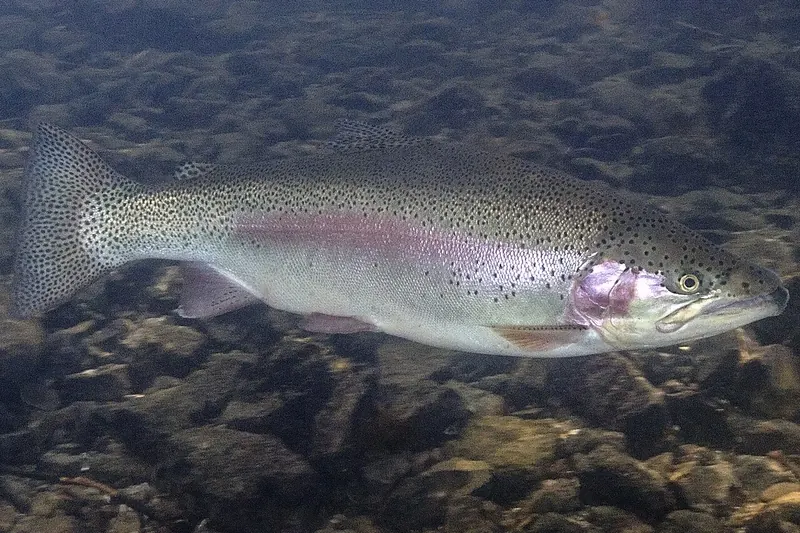
Photo: Liquid Art, Wikimedia Commons, CC BY-SA 4.0, adjusted to 3:2
- Spawning
- December to May in Central Europe (general guide, varies by region)
- German Red List
- not assessed
- Typical method
- Lure fishing (spinning)
- Top bait
- Inline spinner
How to recognise it
- Reddish, shimmering band along the flanks
- Lots of black spots, also on the dorsal and tail fins
- Small adipose fin between the dorsal and tail fins
Easily confused with: Often mistaken for the brown trout: the rainbow trout has a reddish side band and only black spots, the brown trout has red spots with a pale ring.
How to catch it
Methods: Lure fishing (spinning), Fly fishing, Float or bottom fishing
Baits: Inline spinner, Spoon, Trout paste, Flies
Morning and evening, especially in the cooler season from autumn to spring.
Habitat and food
Cool, oxygen-rich rivers and lakes, preferring clear streams. In many waters it does not breed naturally and is stocked, for example in trout lakes.
Insects and their larvae, freshwater shrimp, worms and small fish.
Size and age
Up to around 80 cm and 10 kg; record from a natural water according to Wikipedia around 19.1 kg (Alaska, 1970). Most do not live longer than 7 years, the maximum observed is 11 years (Wikipedia).
Protection and rules
Rainbow trout: closed season and minimum size by German state
These rules apply in Germany only. Fishing in the UK, the USA or elsewhere? The local rules apply there (link below).
- Baden-Württembergclosed season 01.10. to 28.02.
- Bavariaminimum size 26 cm · closed season 15.12. to 15.03.
- Berlinminimum size 25 cm · closed season 01.10. to 30.04.
- Lower Saxonyminimum size 25 cm
- Saxonyminimum size 25 cm · closed season 01.10. to 30.04. only in some watersminimum size 25 cm
- Saxony-Anhaltminimum size 25 cm
From the official state fisheries regulations, retrieved 2026-10-11. All rules by state
In Germany, closed seasons and minimum sizes are set by each state and can be stricter for single waters. All German rules by state, with the legal source. Outside Germany, the local rules apply: licence and agency by country.
In the kitchen
Tender, mild flesh, ideal pan-fried, steamed or smoked; cooked whole, the bones come away easily.
Sources (3)
- de.wikipedia.org/wiki/Regenbogenforelle
- fishbase.se/summary/Oncorhynchus-mykiss.html
- rote-liste-zentrum.de/detail/pdf/91251
Last checked 2026-10-18. Found a mistake? Write to [email protected].
Know more?
Additions, photos of your catches or a mistake in the text: write to us and we will gladly credit you as a helper.
Send a tip