Species
Peacock bass
Tucunaré in Brazil, pavón in Spanish. A colorful cichlid with a peacock eye on the tail that smashes topwater lures like a bully: number one in Gatun Lake on the Panama Canal and established in south Florida.
Cichla ocellaris
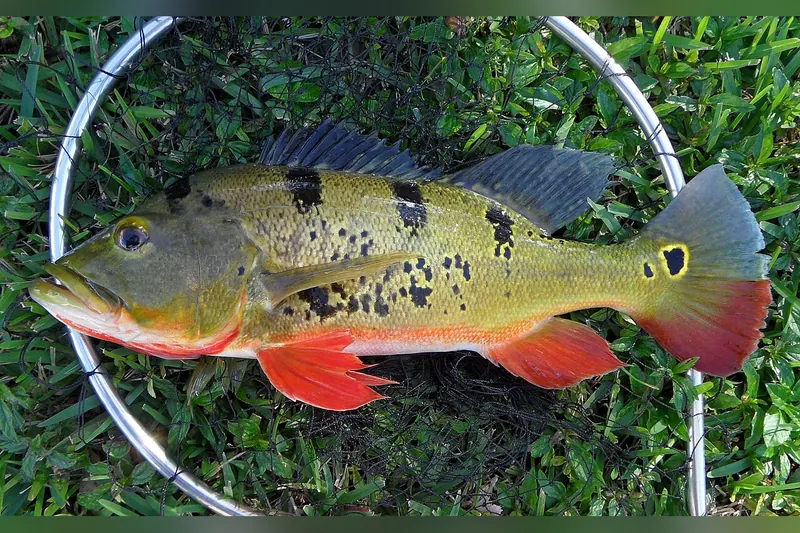
Photo: Theo Modder, Wikimedia Commons, CC BY 4.0, adjusted to 3:2
- Spawning
- Mostly at the start of the rainy season, in Florida April to September with a peak in May and June; both parents guard the nest (Wikipedia). Females lay 9,000 to 15,000 eggs per kg of body weight on a flat stone, larvae hatch after 78 hours at 28 °C (German Wikipedia).
- Typical method
- Casting like for largemouth bass, but it rarely takes plastic worms (Wikipedia)
- Top bait
- Jerkbait
How to recognise it
- Black eyespot with a yellow ring (ocellus) at the tail base
- Three dark vertical bars on a yellow-green to orange body, faded in old fish
- Males develop a nuchal hump on the forehead at spawning time
Easily confused with: The genus has 15 species; the speckled peacock bass (Cichla temensis) is the largest at up to 1 m and 13 kg and is protected in Florida (Wikipedia). Cichla orinocensis has three large gold-rimmed spots instead of bars. Despite the name it is not related to the largemouth bass.
How to catch it
Methods: Casting like for largemouth bass, but it rarely takes plastic worms (Wikipedia), Topwater lures and jerkbaits at timber and shade, Live baitfish (shiners), Fly fishing with poppers and big streamers
Baits: Jerkbait, Popper, Prop bait, Live shiner, Large streamer
Daytime in warm water; prime time around the spawn when fish guard nests in the shallows (Wikipedia). In Panama, Gatun Lake fishes year round (rule of thumb from travel offers).
Habitat and food
Native to the rivers of the three Guianas (Marowijne to Essequibo), in slow stretches and near rapids over rock (FishBase, German Wikipedia). Introduced in south Florida (since 1984, Miami-Dade and Broward), Puerto Rico and Hawaii (Wikipedia). Gatun Lake in Panama has held a peacock bass since the late 1960s, locally called "sargento": Wikipedia lists it as Cichla pleiozona, a 2017 Smithsonian study calls it Cichla monoculus, stocked from Colombia into a pond in 1969 and escaped from there; the Gatun fish is therefore probably not C. ocellaris. Needs warm water: it does not survive below 15.6 °C (60 °F) or above 18 ppt salinity (Wikipedia). Likes shade under trees, bridges and sunken timber.
Almost only small fish, in Florida also tilapia and oscars, plus crayfish and tadpoles; when food is short it eats its own young (FishBase, Wikipedia). Hunts by sight in daylight.
Size and age
FishBase: max. 74 cm, maximum published weight 6.8 kg. In Florida typically 12 to 14 inches, lifespan 6 to 10 years (Wikipedia). We did not verify an IGFA record.
Protection and rules
Size limits, bag limits, seasons and licences are set by each country, in the USA by each state. Pescaday does not list these rules: check them with your operator and the national authority before you fish. Notes with sources are given above under conservation status. Licence pages: Mexico, Belize, Costa Rica, Panama, USA. Fishing travel guide
In the kitchen
White, firm, sweet flesh similar to snapper (Wikipedia). In Florida and in the travel fisheries catch and release dominates.
Sources (6)
Know more?
Additions, photos of your catches or a mistake in the text: write to us and we will gladly credit you as a helper.
Send a tip