Species
Nile perch
Nile perch, sold in Europe as Victoria perch. One of the largest freshwater fish in the world: a silvery giant perch that draws anglers to Lake Victoria, the Nile in Uganda and Lake Nasser in Egypt.
Lates niloticus
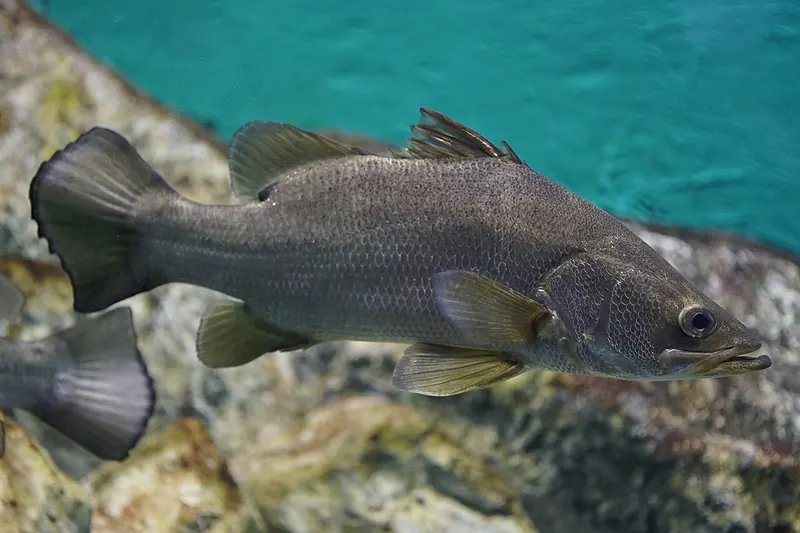
Photo: Daiju Azuma, Wikimedia Commons, CC BY-SA 4.0, adjusted to 3:2
- Spawning
- In spring as the water warms, in sheltered areas or open water (German Wikipedia). Matures at 53 to 85 cm, on average 75.7 cm (FishBase), at three years old according to German Wikipedia.
- Typical method
- Casting lures, which Nile perch attack readily (Wikipedia)
- Top bait
- Large deep-diving crankbait
How to recognise it
- Silver with a bluish sheen, dark eye with a bright yellow ring
- Large protrusible mouth, lower jaw slightly projecting, strong spine on the gill cover
- Dorsal fin split by a deep notch into spiny and soft parts, tail fin rounded
Easily confused with: Lake Tanganyika holds four Lates species of its own that sit genetically within the Nile perch (German Wikipedia) and are hard for anglers to tell apart. The Australian barramundi (Lates calcarifer) looks very similar but does not occur in Africa (Wikipedia). The Nile tilapia shares only the name.
How to catch it
Methods: Casting lures, which Nile perch attack readily (Wikipedia), Trolling big plugs along drop-offs and reefs in the lake (rule of thumb), Bait fishing with fish below rapids and in pools (rule of thumb), Vertical jigging with soft swimbaits on deep drop-offs (rule of thumb)
Baits: Large deep-diving crankbait, Large soft swimbait, Baitfish, live or dead (where allowed), Cut bait, Heavy spoon
Early morning and evening (rule of thumb). The sources give no season; ask your operator about the best months and water levels for each venue.
Habitat and food
Native to the Nilo-Sudan region of Africa: the Senegal, Niger, Volta, Lake Chad and Nile basins, plus the Congo basin and lakes Albert, Turkana and Tana (FishBase); also in brackish Lake Maryut in Egypt (Wikipedia). It was introduced to Lake Victoria in the 1950s according to English Wikipedia, in the early 1960s according to German Wikipedia, and also to Lake Nasser (Wikipedia). Lives in rivers, lakes and irrigation canals at 10 to 60 m, adults in deeper water, juveniles in the shallows (FishBase). Travel destinations for anglers are mainly Uganda, Tanzania, Kenya and Egypt.
Predator: eats mainly fish, especially herring-like fish and characins of the genus Alestes (FishBase), also its own kind, plus crustaceans, molluscs and insects; juveniles feed on zooplankton (Wikipedia). In Lake Victoria it first ate the native cichlids and now mainly takes small shrimp and minnows (Wikipedia).
Size and age
FishBase: max. 200 cm, commonly 100 cm (standard length), maximum published weight 200 kg; the largest measured fish, from Lake Albert, was 180 cm and 164 kg. Mature fish are typically 121 to 137 cm according to English Wikipedia, while German Wikipedia says they usually stay at 85 cm to 1 m. The sources disagree here.
Protection and rules
Size limits, bag limits, seasons and licences are set by each country, in the USA by each state. Pescaday does not list these rules: check them with your operator and the national authority before you fish. Notes with sources are given above under conservation status. Fishing travel guide
In the kitchen
White, firm, full-flavoured flesh, sold in Europe as Victoria perch and high in omega-3 fatty acids (German Wikipedia). Because of its high fat content it is smoked rather than sun-dried around Lake Victoria (Wikipedia).
Sources (4)
- fishbase.se/summary/Lates-niloticus.html
- en.wikipedia.org/wiki/Nile_perch
- de.wikipedia.org/wiki/Nilbarsch
- faolex.fao.org/docs/pdf/ken62309.pdf
Last checked 2026-10-22. Found a mistake? Write to [email protected].
Know more?
Additions, photos of your catches or a mistake in the text: write to us and we will gladly credit you as a helper.
Send a tip