Species
Lingcod
Lingcod: a big mouthed, mottled ambush predator of the rocky reefs on the Pacific coast from Alaska to Mexico, neither a ling nor a cod, but one of the most popular bottom fish on the West Coast.
Ophiodon elongatus
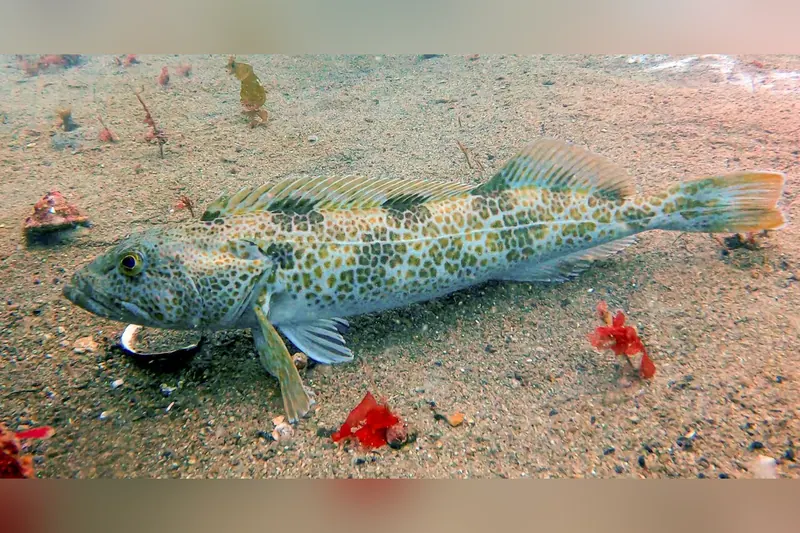
Photo: Will Sides, Wikimedia Commons, CC BY 4.0, adjusted to 3:2
- Spawning
- From late fall or November males claim territories on nearshore spawning grounds; spawning takes place from January to March, probably at night. A female lays up to 500,000 eggs in rock crevices and the male guards the nest (English Wikipedia); the sources differ on how long: 6 weeks (English Wikipedia), 8 to 10 weeks (NOAA Fisheries), 4 to 8 weeks (German Wikipedia). According to NOAA Fisheries males mature at about 2 years and nearly 20 inches, females at about 3 years and 30 inches; German Wikipedia gives about the fourth year.
- Typical method
- Vertical jigging over rocky bottom from a boat (rule of thumb)
- Top bait
- Heavy metal or lead head jig
How to recognise it
- Large, scaleless head with a huge mouth, the upper jaw reaching past the eye, strong canine teeth
- Gray, green or brown mottled with dark spots; about 20 percent of fish have blue green flesh and coloring (English Wikipedia)
- Long dorsal fin split by a notch into a spiny and a soft part; a small flap (cirrus) above each eye
Easily confused with: Despite the name it is related neither to the ling nor to the cods; the only living species of the genus Ophiodon (English and German Wikipedia). Spotted rockfishes (Sebastes) have a smaller mouth and spiny heads (rule of thumb).
How to catch it
Methods: Vertical jigging over rocky bottom from a boat (rule of thumb), Large swimbait on a jig head (rule of thumb), Live bait on a bottom rig (rule of thumb), Heavy jig from rocky shores (rule of thumb)
Baits: Heavy metal or lead head jig, Large swimbait, Live or dead baitfish (such as a small rockfish or herring), Squid
In Alaska recreational lingcod fishing is closed during the spawning and nesting season (NOAA Fisheries). Outside closures fish hold on rocky reefs year round; in winter males move inshore to spawn (English Wikipedia).
Habitat and food
Northeast Pacific from the Shumagin Islands in the Gulf of Alaska to Ensenada, Baja California, Mexico (FishBase), most abundant off British Columbia and Washington (English Wikipedia). On the bottom from the intertidal zone to 475 m (FishBase), most fish over rock at 10 to 100 m (English Wikipedia). Juveniles live on sand with eelgrass or kelp near shore, older fish on rocky reefs, kelp and eelgrass beds and deeper (English Wikipedia). German Wikipedia gives a water temperature of 5 to 16 °C. Largely resident, though migratory populations also exist (English Wikipedia, FishBase).
Aggressive ambush predator that eats almost anything it can fit in its mouth: bottom fish including other lingcod, rockfishes, herring and flatfish, plus squid, octopus and crabs. Larvae eat zooplankton and krill, juveniles small fish and copepods (English and German Wikipedia, FishBase).
Size and age
FishBase: max. 152 cm, maximum published weight 59.1 kg, maximum age 25 years. English Wikipedia: up to 152 cm, confirmed 39 kg (86 lb), reported 59 kg (130 lb); males usually live to 14 and females to 20 years, some beyond 20. NOAA Fisheries: up to 5 feet and 80 lb, more than 20 years. The sources differ on maximum weight.
Protection and rules
In the USA, each state sets its own size limits, bag limits and seasons. Pescaday does not list these rules yet: check them with the fish and wildlife agency of the state you fish in. Fishing licence USA: agency by state
In Germany we found no minimum size or closed season for this species in any state fisheries regulation.
In the kitchen
Popular food fish; the raw flesh is often greenish to blue green and turns white when cooked (English and German Wikipedia). The liver is rich in vitamin A (FishBase). In some regions, for example Alaska, mercury can be a concern (German Wikipedia): follow local advisories. Handle with care, the teeth and gill rakers cut (FishBase).
Sources (4)
- fishbase.se/summary/Ophiodon-elongatus.html
- en.wikipedia.org/wiki/Lingcod
- de.wikipedia.org/wiki/Lengdorsch
- fisheries.noaa.gov/species/lingcod
Last checked 2026-10-22. Found a mistake? Write to [email protected].
Know more?
Additions, photos of your catches or a mistake in the text: write to us and we will gladly credit you as a helper.
Send a tip