Species
Largemouth yellowfish
Largemouth yellowfish, grootbek-geelvis in Afrikaans. A large predatory barb from South Africa's Orange-Vaal system, popular with fly anglers and almost always released.
Labeobarbus kimberleyensis
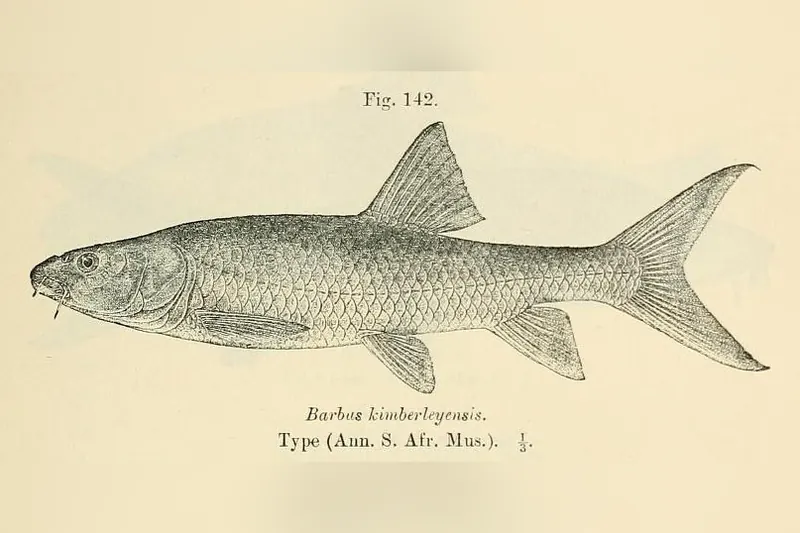
Photo: Boulenger, George Albert, 1858-1937, Wikimedia Commons, Public domain, adjusted to 3:2
- Spawning
- In mid to late summer over gravel beds in running water (FishBase), around December to January in riffles according to English and German Wikipedia. Large females lay over 60,000 eggs per season (Wikipedia). Slow growing: 30 cm only after five years (Wikipedia). Matures on average at 51.8 cm (FishBase).
- Typical method
- Fly fishing in riffles and below rapids (Wild Trout Association: "can be taken on fly")
- Top bait
- Streamer (fly)
How to recognise it
- Terminal mouth and longer head than the smallmouth yellowfish
- Silver colour, sturdy scaled barb body
- The largest indigenous scaled fish in southern Africa
Easily confused with: The smallmouth yellowfish (Labeobarbus aeneus) lives in the same river system and shares mtDNA lineages with it, but looks different and stays smaller (Wikipedia); the largemouth has a terminal mouth and a longer head (Wild Trout Association).
How to catch it
Methods: Fly fishing in riffles and below rapids (Wild Trout Association: "can be taken on fly"), Casting small crankbaits and spinners, as large fish eat fish (rule of thumb), Feeder fishing on dams (rule of thumb), Gentle fight and quick release (rule of thumb)
Baits: Streamer (fly), Nymph (fly), Small crankbait, Spinner, Small baitfish (where allowed)
In the South African summer, when the water is warm and the fish run to spawn (rule of thumb based on the FishBase spawning season); fish with extra care during spawning.
Habitat and food
Only in the Orange-Vaal river system (FishBase), including larger tributaries such as the Riet, in Lesotho, Namibia and South Africa; there in the Eastern Cape, Free State, Gauteng, Mpumalanga, North West and Northern Cape provinces (Wikipedia). Adults hold in flowing water of deep channels and below rapids but also do well in dams (FishBase), especially in pools deeper than 2 m in large rivers and in slow water above weirs, for example Sterkfontein Dam; aquatic plants and vegetated banks are important (Wikipedia). The destination is South Africa.
Predator: insects and small crustaceans at first, mainly fish from about 30 cm fork length (FishBase); adults feed almost exclusively on fish (Wikipedia).
Size and age
FishBase: max. 82.5 cm fork length, maximum published weight 22.2 kg, lives 12 years or more. German Wikipedia gives up to 120 cm, a rod-caught fish of 22 kg from the Vaal Dam and a commercially caught fish of 52 kg; these figures differ widely from FishBase and are not supported there.
Protection and rules
Size limits, bag limits, seasons and licences are set by each country, in the USA by each state. Pescaday does not list these rules: check them with your operator and the national authority before you fish. Notes with sources are given above under conservation status. Fishing travel guide
In the kitchen
Used as a food fish and partly exported to North America (FishBase, German Wikipedia). As an apex predator it may accumulate toxins and should be released until water quality improves (Wikipedia).
Sources (4)
Know more?
Additions, photos of your catches or a mistake in the text: write to us and we will gladly credit you as a helper.
Send a tip