Species
Great barracuda
The pike of the reefs: long, silver, with fearsome teeth and an attack from a standing start. On the flats from Belize to the Bahamas it is the fish that takes any lure.
Sphyraena barracuda
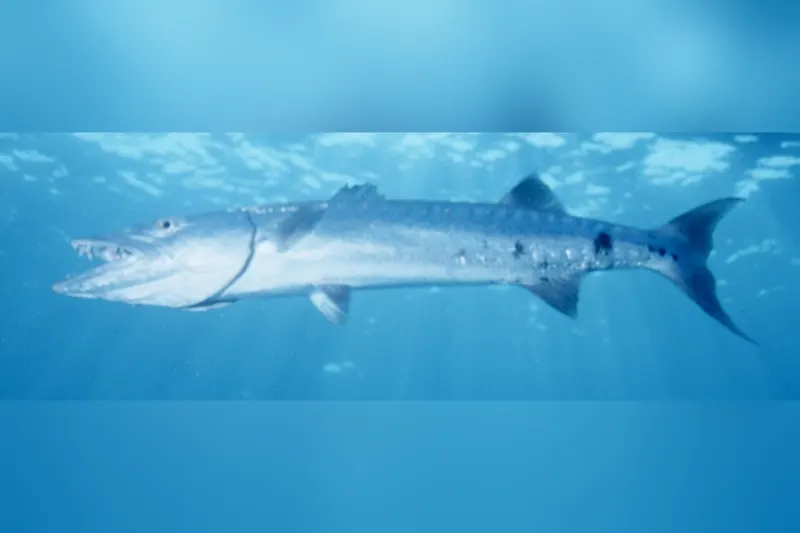
Photo: Albert Kok, Wikimedia Commons, Public domain, adjusted to 3:2
- Spawning
- Not well studied: April to October with a peak in July to September, eggs released into open water of shallow coastal areas; 5,000 to 30,000 eggs per female (Wikipedia). The sources disagree on maturity: English Wikipedia gives Florida females at 1 to 2 and males at 3 to 4 years, German Wikipedia males at 2 and females at 4 years.
- Typical method
- Casting long fast-retrieved plugs and stickbaits
- Top bait
- Long plug or stickbait
How to recognise it
- Long pike-like head, projecting lower jaw, large fang-like teeth of unequal size
- Two widely separated dorsal fins
- Blue-grey back, silvery white belly, often dark bars above and black blotches on the lower sides; second dorsal, anal and tail fins dark with white tips
Easily confused with: Smaller Caribbean barracudas (for example Sphyraena picudilla) stay much smaller; the great barracuda reaches 2 m (FishBase). The eastern Atlantic has the Guinean barracuda (Sphyraena afra) at up to 2.05 m (German Wikipedia).
How to catch it
Methods: Casting long fast-retrieved plugs and stickbaits, Trolling spoons or baitfish along reef edges, Live baitfish under a float, Fly fishing with long needlefish streamers on the flats
Baits: Long plug or stickbait, Spoon, Live baitfish, Needlefish streamer (fly), Wire or heavy fluorocarbon leader because of the teeth (rule of thumb)
Daytime (FishBase: diurnal) at reef edges, wrecks and on the flats, where big barracuda use the warmer shallows in winter (rule of thumb). A fast retrieve triggers the strike (rule of thumb).
Habitat and food
Red Sea and tropical Indo-Pacific to Hawaii, western Atlantic from Massachusetts through Bermuda and the Caribbean to southern Brazil, eastern Atlantic from Mauritania to São Tomé; absent from the eastern Pacific (German Wikipedia). Mostly at or near the surface, 0 to 100 m, usually 3 to 30 m; juveniles in mangroves, estuaries and inner reefs, adults from murky harbors to the open sea (FishBase). Diurnal and mostly solitary (FishBase).
About 95 percent fish (herrings, sardines, gobies, anchovies, lizardfish), plus cephalopods and occasionally shrimp (German and English Wikipedia).
Size and age
FishBase: max. 200 cm, commonly around 140 cm, maximum published weight 50 kg, maximum age 18 years. Mature fish usually 60 to 100 cm and 2.5 to 9 kg, exceptional fish over 1.5 m and 23 kg; record rod-and-reel catch 46.72 kg (103 lb) at 1.7 m; lifespan at least 14 years (Wikipedia). Bursts up to 36 mph (58 km/h) (Wikipedia).
Protection and rules
Size limits, bag limits, seasons and licences are set by each country, in the USA by each state. Pescaday does not list these rules: check them with your operator and the national authority before you fish. Notes with sources are given above under conservation status. Licence pages: Mexico, Belize, Costa Rica, Panama, USA. Fishing travel guide
In the kitchen
Marketed fresh, dried and salted (German Wikipedia). Large fish can carry ciguatoxins, especially in the Caribbean; no poisonings are known from the eastern Atlantic (FishBase, German Wikipedia). So do not eat big barracuda, release them (rule of thumb).
Sources (3)
- fishbase.se/summary/Sphyraena-barracuda.html
- en.wikipedia.org/wiki/Great_barracuda
- de.wikipedia.org/wiki/Gro%C3%9Fer_Barrakuda
Last checked 2026-10-19. Found a mistake? Write to [email protected].
Know more?
Additions, photos of your catches or a mistake in the text: write to us and we will gladly credit you as a helper.
Send a tip