Species
Goliath tigerfish
Goliath tigerfish, giant tigerfish, called mbenga in the Congo. Africa's largest characin with dagger-like teeth and, for many anglers, one of the toughest challenges in fresh water; fishing trips go to the Congo.
Hydrocynus goliath
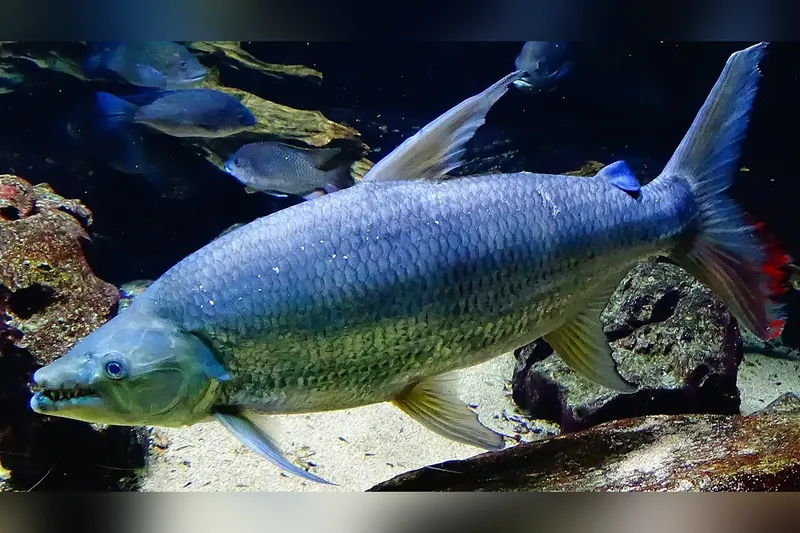
Photo: Cedricguppy - Loury Cédric, Wikimedia Commons, CC BY-SA 4.0, adjusted to 3:2
- Spawning
- Females migrate together and spawn along river or lake shores in dense vegetation; there is no parental care. Juveniles grow slowly, about 4 to 6 inches (roughly 10 to 15 cm) per year, and take up to ten years to reach full size (Wikipedia). The sources give no season.
- Typical method
- Bottom fishing with large fish chunks in eddies below rapids (rule of thumb)
- Top bait
- Large fish chunk
How to recognise it
- Silver-grey back and flanks, lengthwise stripes faint or absent
- Huge dagger-shaped interlocking teeth, deeply cleft mouth
- Deeply forked tail with a thick base, black adipose fin
Easily confused with: The African tigerfish (Hydrocynus vittatus) shares part of the range but has clear black stripes and stays smaller (FishBase, German Wikipedia). A 2011 study found further, still undescribed tigerfish lineages in the Congo basin (Wikipedia).
How to catch it
Methods: Bottom fishing with large fish chunks in eddies below rapids (rule of thumb), Casting heavy spoons and large plugs (rule of thumb), Drifting with baitfish from a boat (rule of thumb), Heavy tackle with a wire leader (rule of thumb)
Baits: Large fish chunk, Whole baitfish, Heavy spoon, Large crankbait
The sources give no season. Ask your operator about the travel season and water level on the Congo (rule of thumb).
Habitat and food
Only in the Congo basin, from the lower Congo to the upper Lualaba, in the Democratic Republic of the Congo and the Republic of the Congo, plus reports from Lake Tanganyika (FishBase); also in Lake Upemba (Wikipedia). Lives in lakes and large rivers (FishBase), mainly in well-oxygenated fast water of deep river channels and open lakes (Wikipedia). Prefers 23 to 26 °C (FishBase). The main destination for anglers is the Democratic Republic of the Congo.
Eats only fish, taking any fish it can overpower, including smaller members of its own species, and bites chunks out of large prey. It ambushes from calmer eddies in rapids (English and German Wikipedia). Both Wikipedias report attacks on people.
Size and age
FishBase: max. 133 cm fork length, maximum published weight 50 kg. English Wikipedia gives much more: an average of 1.5 m and 50 kg, a heaviest specimen of 70 kg and a maximum length of about 2 m. German Wikipedia says well over a metre and calls reports of 180 cm unconfirmed. The sources differ widely.
Protection and rules
Size limits, bag limits, seasons and licences are set by each country, in the USA by each state. Pescaday does not list these rules: check them with your operator and the national authority before you fish. Notes with sources are given above under conservation status. Fishing travel guide
In the kitchen
Considered a good food fish and used locally (German Wikipedia), often traded dried; dried tigerfish is frequently infested by Dermestes beetles (Wikipedia).
Sources (3)
- fishbase.se/summary/Hydrocynus-goliath.html
- en.wikipedia.org/wiki/Hydrocynus_goliath
- de.wikipedia.org/wiki/Riesen-Tigersalmler
Last checked 2026-10-22. Found a mistake? Write to [email protected].
Know more?
Additions, photos of your catches or a mistake in the text: write to us and we will gladly credit you as a helper.
Send a tip