Species
Crevalle jack
Also called jack crevalle. The brawler of the Caribbean: a jack with a steep forehead and a black spot on the gill cover that drives baitfish to the surface in schools and fights longer on light tackle than almost any fish its size.
Caranx hippos
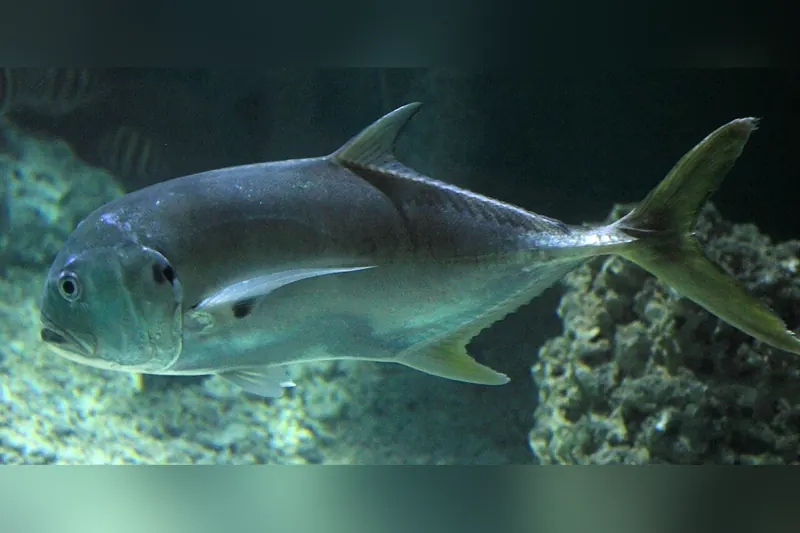
Photo: Yinan Chen, Wikimedia Commons, Public Domain, adjusted to 3:2
- Spawning
- Year round with regional peaks, for example April and May in Cuba and March to September south of Florida; up to one million pelagic eggs (Wikipedia). Males mature at 55 cm (4 to 5 years), females at 66 cm (5 to 6 years).
- Typical method
- Casting poppers and spoons at feeding schools
- Top bait
- Popper
How to recognise it
- Black spot on the upper edge of the gill cover and a dark spot on the pectoral fin
- Steep high forehead, body deep and moderately compressed
- Back brassy green to blue-black, belly silvery white to golden; 23 to 35 scutes on the rear lateral line; juveniles with about five dark bars
Easily confused with: The horse-eye jack (Caranx latus) has a larger eye and no spot on the pectoral fin; it is linked to more ciguatera cases (Wikipedia). Reports from the Indian Ocean are confusion with Caranx ignobilis (German Wikipedia).
How to catch it
Methods: Casting poppers and spoons at feeding schools, Live or cut bait (Wikipedia), Trolling plugs at passes and reef edges, Fly fishing with big streamers and poppers
Baits: Popper, Spoon, Live baitfish (pilchard, mullet), Cut bait, Large streamer
Wherever bait "boils" at the surface and birds dive; at passes on the falling tide (rule of thumb). Light tackle but a heavy leader, because the fish fight hard (Wikipedia).
Habitat and food
Western Atlantic from Nova Scotia to Uruguay including the Caribbean and Gulf of Mexico, absent from the eastern Lesser Antilles; eastern Atlantic from Portugal to Angola (German and English Wikipedia). Over the shelf from 1 to 350 m, usually 1 to 200 m, also on shallow flats; juveniles in brackish water, mangroves and seagrass, adults ascend rivers, recorded salinities from 0 to 49 ppt (FishBase, Wikipedia). Fast-moving schools, big fish often solitary.
Mainly smaller fish (74 to 94 percent of the diet in a southern US study), plus prawns, crabs, mollusks and mantis shrimp (Wikipedia, FishBase).
Size and age
FishBase: max. 124 cm, commonly around 75 cm, maximum published weight 32 kg; rare above 60 to 65 cm, oldest studied fish 17 years (Wikipedia). Record fish according to Odu Magazine and Sport Fishing: 66 lb 2 oz (30 kg) off Angola, 2010; IGFA database not accessed.
Protection and rules
Size limits, bag limits, seasons and licences are set by each country, in the USA by each state. Pescaday does not list these rules: check them with your operator and the national authority before you fish. Notes with sources are given above under conservation status. Licence pages: Mexico, Belize, Costa Rica, Panama, USA. Fishing travel guide
In the kitchen
Generally considered poor table fare: dark coarse flesh; young fish bled on capture taste best (Wikipedia). Several ciguatera cases are documented (Wikipedia). Mostly catch and release.
Sources (3)
- fishbase.se/summary/Caranx-hippos.html
- en.wikipedia.org/wiki/Crevalle_jack
- de.wikipedia.org/wiki/Cavalla
Last checked 2026-10-19. Found a mistake? Write to [email protected].
Know more?
Additions, photos of your catches or a mistake in the text: write to us and we will gladly credit you as a helper.
Send a tip