Species
Common snook
Also called robalo in Latin America. The zander of the mangroves: a slender predator with a black lateral line that ambushes prey at mangrove roots, bridges and river mouths from Florida to Brazil.
Centropomus undecimalis
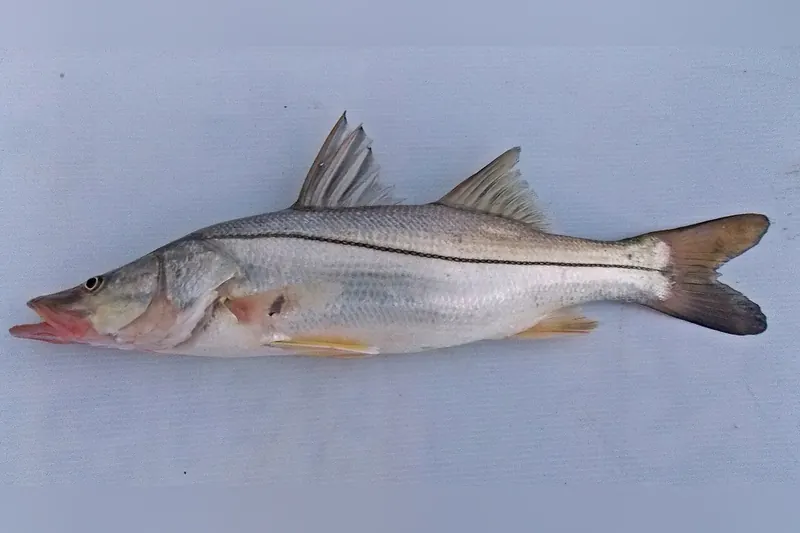
Photo: jose_colorado-dapa, Wikimedia Commons, CC BY-SA 4.0, adjusted to 3:2
- Spawning
- FishBase says mature fish gather at passes and river mouths from May to September; Wikipedia gives April to October with a peak in July and August, in high-salinity nearshore water. Snook are protandric hermaphrodites: first male, later female (Wikipedia).
- Typical method
- Casting along mangrove edges and bridge pilings
- Top bait
- Live mullet or pilchard
How to recognise it
- Distinct black lateral line running onto the tail fin
- Concave forehead, lower jaw longer than the upper
- Two separate dorsal fins; pelvic and tail fins often yellow at spawning time
Easily confused with: Belize and Mexico have other snook species (Centropomus parallelus, C. pectinatus, C. ensiferus, C. poeyi) that stay smaller; the genus has 13 species (German Wikipedia). The common snook is the largest at up to 140 cm (FishBase). Our sources give no single reliable field mark, so ask your guide if in doubt.
How to catch it
Methods: Casting along mangrove edges and bridge pilings, Night fishing at lit docks (rule of thumb), Live baitfish under a float, Fly fishing with streamers in the shallows
Baits: Live mullet or pilchard, Shrimp, Soft plastic on a jig head, Shallow plug, Topwater lure
Around the summer spawn the fish stack up at passes and river mouths (FishBase). After cold snaps they move into warmer canals and rivers; in Florida the harvest season is closed regionally during the spawn and in winter (see rules).
Habitat and food
Western Atlantic from southern Florida and the Gulf of Mexico through the Antilles and the Caribbean coasts of Central and South America to Rio de Janeiro (FishBase). Coastal waters, estuaries and lagoons to about 20 m, also mangroves; regularly moves into fresh water (FishBase). Very sensitive to cold: it stops feeding at 14.2 °C and dies at 12.5 °C, and the January 2010 cold snap cut the southwest Florida population by about 42 percent (Wikipedia).
Mainly smaller fish (gobies, mojarras, anchovies) and crustaceans such as shrimp and crabs; large snook occasionally eat juveniles of their own species (FishBase, Wikipedia).
Size and age
FishBase: max. 140 cm, commonly around 50 cm, maximum published weight 24.3 kg, maximum age 7 years. IGFA all-tackle record according to Wikipedia: 24.32 kg (53 lb 10 oz) from Parismina, Costa Rica.
Protection and rules
Size limits, bag limits, seasons and licences are set by each country, in the USA by each state. Pescaday does not list these rules: check them with your operator and the national authority before you fish. Notes with sources are given above under conservation status. Licence pages: Mexico, Belize, Costa Rica, Panama, USA. Fishing travel guide
In the kitchen
Excellent food fish, fished commercially (FishBase, Wikipedia). Remove the skin before cooking because it tastes soapy (Wikipedia). Florida applies slot limits and closed seasons.
Sources (6)
Know more?
Additions, photos of your catches or a mistake in the text: write to us and we will gladly credit you as a helper.
Send a tip