Species
Cobia
Cobia, a curious, shark-like loner that follows rays, turtles and buoys and moves north along the Gulf Coast and Florida in spring.
Rachycentron canadum
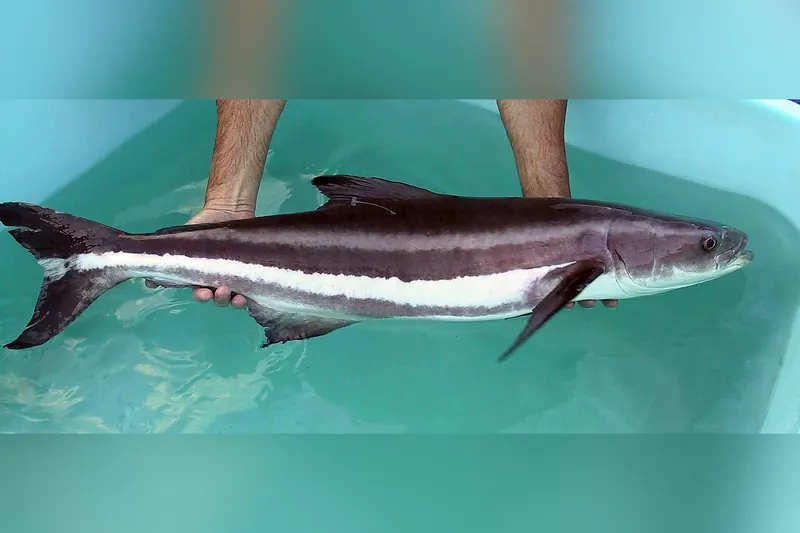
Photo: Jorge Alarcon or Dr. Daniel Benetti, Wikimedia Commons, Public domain, adjusted to 3:2
- Spawning
- In the western Atlantic spawning aggregations form in the warm months (FishBase); according to Wikipedia from April to September, by day in large offshore groups, and a female can spawn up to 30 times a season. Males mature at two, females at three years (Wikipedia).
- Typical method
- Sight fishing: look for fish around rays, turtles, buoys and debris and cast to them (Wikipedia, rule of thumb)
- Top bait
- Live crab
How to recognise it
- Broad, flat head and six to nine short, stout, free spines in front of the long dorsal fin (FishBase, Wikipedia)
- Dark brown with pale silvery stripes along the flanks, belly yellowish to white (FishBase, German Wikipedia)
- Large pectoral fins held horizontally, giving a shark-like outline in the water (Wikipedia)
Easily confused with: Remoras: close relatives that look similar, but with a sucker disc on the head and a slimmer body (Wikipedia). In the water a cobia is easily mistaken for a small shark because of its pectoral fins and dark colour (Wikipedia).
How to catch it
Methods: Sight fishing: look for fish around rays, turtles, buoys and debris and cast to them (Wikipedia, rule of thumb), Fish wrecks, reefs, pilings and harbour structures where cobia gather (Wikipedia), Cast a heavy bucktail jig or soft plastic in front of the fish (rule of thumb), Live bait on the bottom or free-lined (rule of thumb)
Baits: Live crab, Live baitfish, Squid, Bucktail jig, Large soft plastic
Winters in the Gulf of Mexico and moves north as far as Massachusetts in summer, passing Florida around March (Wikipedia). The April to September spawning season brings aggregations offshore (Wikipedia).
Habitat and food
Worldwide in tropical and subtropical seas, absent from the eastern Pacific; in the western Atlantic from Canada, Bermuda and Massachusetts to Argentina including the Gulf of Mexico and the Caribbean, in the eastern Atlantic from Morocco to South Africa, in the Indo-West Pacific from East Africa and Hokkaido to Australia (FishBase). Over mud, sand and gravel, on reefs, rocky shores and in mangroves, inshore around pilings and buoys, offshore around drifting and fixed objects, occasionally in estuaries (FishBase). Depth 0 to 1200 m, 17 to 32 °C (FishBase); Wikipedia gives 1.6 to 32.2 °C. Introduced to the eastern Pacific since 2015 after escapes from a farm off Ecuador (Wikipedia).
Crustaceans, especially crabs, plus small fish and squid (FishBase, Wikipedia). Like remoras it follows large animals such as sharks, turtles and manta rays to scavenge, and shows little fear of boats (Wikipedia).
Size and age
FishBase: max. 200 cm, commonly around 110 cm, maximum published weight 68 kg, maximum age 15 years. Wikipedia gives up to 79 kg and an IGFA record of 79.6 kg (175 lb) near Rottnest Island, Australia; German Wikipedia up to 70 kg. The weight figures contradict each other.
Protection and rules
In the USA, each state sets its own size limits, bag limits and seasons. Pescaday does not list these rules yet: check them with the fish and wildlife agency of the state you fish in. Fishing licence USA: agency by state
In Germany we found no minimum size or closed season for this species in any state fisheries regulation.
In the kitchen
Firm flesh with excellent flavour that commands high prices; usually sold fresh and served as grilled or poached fillets (Wikipedia). There is no dedicated wild fishery because cobia live alone; the species is farmed (Wikipedia).
Sources (7)
- fishbase.se/summary/Rachycentron-canadum.html
- en.wikipedia.org/wiki/Cobia
- de.wikipedia.org/wiki/Cobia
- api.gbif.org/v1/species/2391729/vernacularNames
- ecfr.gov/current/title-50/chapter-VI/part-622/subpart-Q/section-622.38
- ecfr.gov/current/title-50/chapter-VI/part-622/subpart-Q/section-622.38
- fisheries.noaa.gov/southeast/rules-regulations/fishing-regulations-and
Last checked 2026-10-22. Found a mistake? Write to [email protected].
Know more?
Additions, photos of your catches or a mistake in the text: write to us and we will gladly credit you as a helper.
Send a tip