Species
Calico bass
Calico bass, also called kelp bass: a mottled sea bass of the kelp forests of Southern California and Baja California and one of the most sought after game fish on the coast.
Paralabrax clathratus
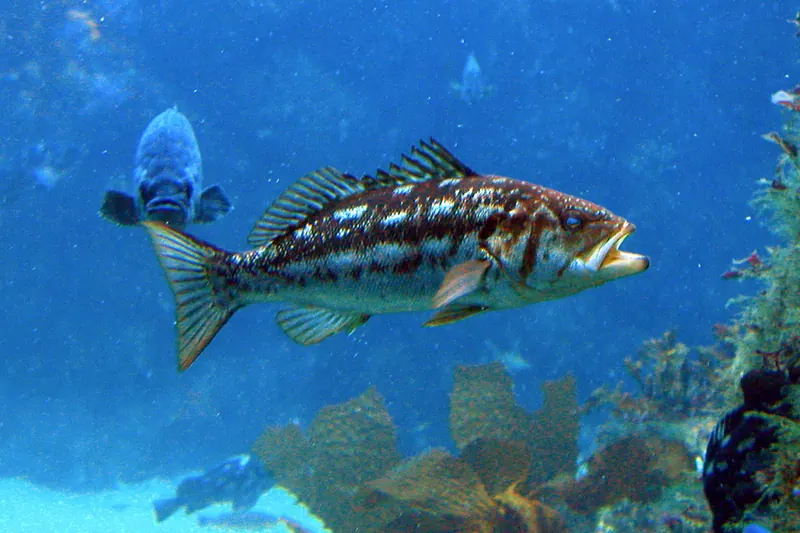
Photo: Steve Lonhart (SIMoN / MBNMS), Wikimedia Commons, Public domain, adjusted to 3:2
- Spawning
- Late spring to early fall with a summer peak, in aggregations of usually about 50 and up to 200 fish around kelp or piers at 8 to 18 m, mostly around sunset and more often near the full moon; eggs hatch within 36 hours (English Wikipedia). Maturity: males at 2 to 4, females at 2 to 5 years, half of them at about 22 cm (English Wikipedia).
- Typical method
- Swimbait on a jig head along kelp edges (rule of thumb)
- Top bait
- Live anchovy
How to recognise it
- Brown to olive green with black, white and olive blotches, and rows of white rectangular spots along the back
- Piebald, multicolored spotting on the belly (hence calico bass); all fins with yellow tips
- Large mouth with protruding lower jaw, large spine on the gill cover; dorsal fin with 10 spines (English Wikipedia)
Easily confused with: The related barred sand bass (Paralabrax nebulifer) and spotted sand bass (Paralabrax maculatofasciatus) live in the same area and share one bag limit in California (CDFW). Calico bass are told apart by the piebald belly spotting and the white rectangular spots on the back (English Wikipedia).
How to catch it
Methods: Swimbait on a jig head along kelp edges (rule of thumb), Fly-lined live anchovy at the kelp (rule of thumb), From a boat over rocky reefs and kelp beds (rule of thumb), From piers and jetties with live bait (rule of thumb)
Baits: Live anchovy, Live sardine, Swimbait, Squid strips
Because of the spawning aggregations most fish are caught in June, July and August; from October through April virtually none are caught (English Wikipedia). Dusk along the kelp edge is a good time (rule of thumb).
Habitat and food
Northeast Pacific from central California to the tip of Baja California; formerly north to the mouth of the Columbia River, now rare north of Point Conception (English Wikipedia, FishBase). Almost always in kelp forests, also on nearshore rocky reefs and in estuaries, at 0 to 61 m, typically 2.7 to 21.3 m (English Wikipedia); FishBase gives 1 to 61 m, usually 3 to 25 m. Strongly site attached, with home ranges averaging about 3,000 m² (English Wikipedia).
Juveniles eat plankton and small bottom animals such as small crustaceans and brittle stars; adults small fish, crustaceans, mollusks and cephalopods, and all ages take zooplankton when it is abundant. Food is scarce in winter (English Wikipedia, FishBase).
Size and age
FishBase and English Wikipedia: max. 72 cm, maximum published weight 7.0 kg, maximum age 34 years; in the wild rarely older than 15 years, and about 40 percent of fish are 20 to 25 cm long (English Wikipedia).
Protection and rules
In the USA, each state sets its own size limits, bag limits and seasons. Pescaday does not list these rules yet: check them with the fish and wildlife agency of the state you fish in. Fishing licence USA: agency by state
In Germany we found no minimum size or closed season for this species in any state fisheries regulation.
In the kitchen
Considered excellent eating (English Wikipedia, FishBase).
Sources (5)
Know more?
Additions, photos of your catches or a mistake in the text: write to us and we will gladly credit you as a helper.
Send a tip