Species
Atlantic bluefin tuna
Atlantic bluefin tuna, one of the largest bony fishes and a classic big game target; the biggest fish are called giant bluefin.
Thunnus thynnus
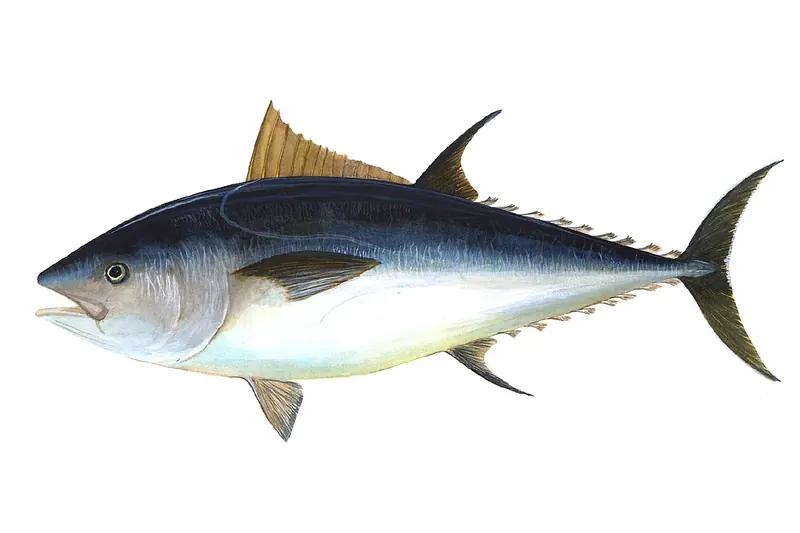
Photo: Unknown authorUnknown author, Wikimedia Commons, Public domain, adjusted to 3:2
- Spawning
- Two known spawning grounds: the Gulf of Mexico (western stock) and the western Mediterranean around the Balearic Islands (eastern stock); since 2016 a third has been suggested in the Slope Sea off the northeastern US (Wikipedia). In the Gulf from mid-April to mid-June, in the Mediterranean from June to August (Wikipedia, FishBase). Spawning water temperature according to FishBase 22.6 to 27.5 °C in the Gulf and 22.5 to 25.5 °C in the Mediterranean, according to Wikipedia 24 to 29 °C and 18 to 21 °C. Large females over 205 cm carry a mean of 30 to 60 million eggs in the west and 13 to 15 million in the east (FishBase).
- Typical method
- Trolling lures and spreader bars (rule of thumb)
- Top bait
- Live mackerel
How to recognise it
- Very short pectoral fins, under 80 percent of head length (FishBase)
- Second dorsal fin taller than the first and reddish-brown, first yellow or bluish (FishBase)
- Finlets yellow edged with black, median caudal keel black in adults (FishBase, Wikipedia)
Easily confused with: Yellowfin tuna: longer pectoral fins, sickle-shaped yellow dorsal and anal fins (Wikipedia, Yellowfin tuna). Other tunas are usually much smaller and recognisable by stripes, bands or dots (FishBase). The closely related Pacific bluefin tuna (Thunnus orientalis) lives in the Pacific and was formerly treated as the same species (Wikipedia).
How to catch it
Methods: Trolling lures and spreader bars (rule of thumb), Chunking with cut bait and drifting natural baits (rule of thumb), Live bait such as mackerel or herring (rule of thumb), Jigging and poppers on feeding schools (rule of thumb)
Baits: Live mackerel, Herring, Whole squid, Skirted trolling lure, Metal jig or popper
Comes close to shore seasonally (FishBase). US rules split trophy areas into Gulf of Maine, Southern New England, South and Gulf of America, each with its own quota (NOAA Fisheries); whether an area is open is only shown on the current NOAA page. Prince Edward Island and Nova Scotia are famous giant bluefin grounds (Wikipedia).
Habitat and food
Western Atlantic from Labrador and Newfoundland into the Gulf of Mexico and across the Caribbean to Venezuela and Brazil; eastern Atlantic from the Lofoten Islands to the Canaries including the Mediterranean, plus a subpopulation off South Africa (FishBase). Oceanic, seasonally close to shore; 0 to 985 m, usually 0 to 100 m, at 3 to 30 °C (FishBase). Keeps its muscles warm like hardly any other fish, so it can hunt in the cold North Atlantic (Wikipedia). Regionally extinct in the Black Sea according to Wikipedia, while FishBase still lists the southern Black Sea.
Hunts by sight for small schooling fish such as anchovies, sauries and hakes, plus squid and red crabs (FishBase); German Wikipedia also lists mackerel, needlefish, flying fish and herring.
Size and age
FishBase: max. 458 cm, commonly around 200 cm fork length, maximum published weight 684 kg, maximum age 32 years; elsewhere FishBase mentions up to 40 years in the western Atlantic and up to 900 kg. Mean length at maturity 103.5 cm (FishBase), according to German Wikipedia at 4 to 5 years and 1.2 to 1.4 m. Adults average 2 to 2.5 m and 225 to 250 kg; IGFA all-tackle record 679 kg (1,497 lb), 3.84 m, off North Lake, Prince Edward Island, Canada (Wikipedia). German Wikipedia gives a maximum age of only 15 years, which contradicts FishBase.
Protection and rules
In the USA, each state sets its own size limits, bag limits and seasons. Pescaday does not list these rules yet: check them with the fish and wildlife agency of the state you fish in. Fishing licence USA: agency by state
In Germany we found no minimum size or closed season for this species in any state fisheries regulation.
In the kitchen
Deep dark red meat that stays dark when cooked (German Wikipedia); highly prized in Japan for sushi and sashimi, especially the fatty belly (otoro) (Wikipedia). A large share of the Mediterranean catch goes to Japan (German Wikipedia).
Sources (6)
- fishbase.se/summary/Thunnus-thynnus.html
- en.wikipedia.org/wiki/Atlantic_bluefin_tuna
- de.wikipedia.org/wiki/Roter_Thun
- en.wikipedia.org/wiki/Yellowfin_tuna
- fisheries.noaa.gov/permit/atlantic-highly-migratory-species-angling-pe
- fisheries.noaa.gov/atlantic-highly-migratory-species/recreational-atla
Last checked 2026-10-22. Found a mistake? Write to [email protected].
Know more?
Additions, photos of your catches or a mistake in the text: write to us and we will gladly credit you as a helper.
Send a tip