Species
Blue catfish
The blue catfish is North America's largest catfish: a blue-gray forked-tail catfish of the big rivers and reservoirs of the Mississippi basin that can top 60 kg (English and German Wikipedia).
Ictalurus furcatus
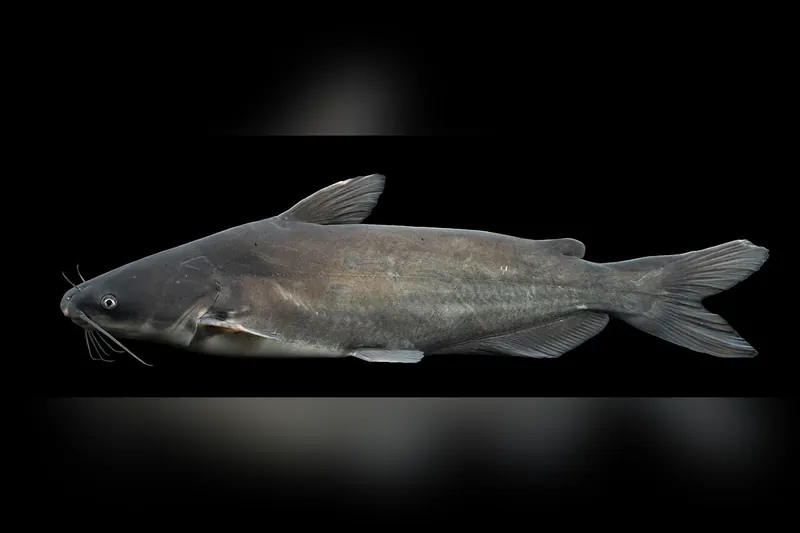
Photo: USFWS Mountain Prairie, Wikimedia Commons, Public domain, adjusted to 3:2
- Spawning
- Once a year from May to June; females produce 2,000 to 4,000 eggs per pound of body weight (Wikipedia). Eggs are deposited in nests under logs, brush or riverbanks, males often build nests in pools or backwaters (FishBase).
- Typical method
- Bottom fishing with cut bait in channels and below dams (Wikipedia on spillways, rule of thumb)
- Top bait
- Fresh cut bait (shad, herring)
How to recognise it
- Heavy, blue-gray body with a hump in front of the dorsal fin, usually without spots (English and German Wikipedia)
- Deeply forked tail, protruding upper jaw, eight barbels, adipose fin (Wikipedia, rule of thumb for barbel count in North American catfish)
- Long anal fin with 30 to 36 rays (English and German Wikipedia)
Easily confused with: Channel catfish: the most reliable feature is the anal fin with only 25 to 29 rays (Wikipedia), plus usually dark spots; blue catfish mostly lack them, only the Rio Grande population is spotted (German Wikipedia). Flathead catfish: flat head, protruding lower jaw and barely forked tail (rule of thumb).
How to catch it
Methods: Bottom fishing with cut bait in channels and below dams (Wikipedia on spillways, rule of thumb), Drifting natural baits over deep river stretches (rule of thumb), Anchoring on deep ledges, especially at night (German Wikipedia on feeding time, rule of thumb), Open-water fishing beneath feeding schools of striped bass in reservoirs (Wikipedia)
Baits: Fresh cut bait (shad, herring), Whole bait fish, Mussel or clam meat, Sausage or stink bait (rule of thumb), Crayfish
Most active at night between midnight and sunrise (German Wikipedia). In summer it moves upstream to cooler water, in winter downstream to warmer stretches (German Wikipedia); in reservoirs it feeds on injured fish below turbines and spillways (Wikipedia).
Habitat and food
Mississippi basin from western Pennsylvania to South Dakota and the Platte River in Nebraska, south to the Gulf; Gulf Slope to the Rio Grande in Texas and New Mexico and Mexico; introduced on the Atlantic slope, in the West and in Minnesota (FishBase). Wikipedia gives Belize and Guatemala as the southern limit. Lives in deep water of reservoirs, main channels and backwaters of medium to large rivers over mud, sand and gravel, preferring clear, strongly flowing water, down to 50 m; on the bottom in deep areas by day, moving into swifter water at night to feed (FishBase). Tolerates brackish water and is considered invasive in Chesapeake Bay and Albemarle Sound (Wikipedia).
Opportunistic predator: any fish it can take, cannibalism included, plus insects, crayfish, crabs, mussels, worms and frogs; one of the few fish in the Mississippi basin able to eat adult Asian carp (Wikipedia). Up to 10 cm it eats zooplankton, from 24 cm larger fish, and then feeds mainly between midnight and sunrise (German Wikipedia). In Chesapeake Bay researchers found a lot of plant matter (hydrilla) and Asian clams (Wikipedia).
Size and age
FishBase: max. 165 cm, maximum published weight 68 kg, maximum age 21 years. According to Wikipedia up to 170 cm (65 in) and 65 kg (143 lb), up to 20 years old, typically 64 to 117 cm (25 to 46 in) and 14 to 32 kg (30 to 70 lb); German Wikipedia gives up to 135 cm, an average of 10 to 20 kg and a confirmed maximum of 65 kg. Largest documented rod-caught fish according to Wikipedia: 143 lb (64.9 kg) and 57 in (145 cm) from Kerr Lake on the Virginia and North Carolina line, 2011, certified as a state record by the Virginia Department of Game and Inland Fisheries.
Protection and rules
In the USA, each state sets its own size limits, bag limits and seasons. Pescaday does not list these rules yet: check them with the fish and wildlife agency of the state you fish in. Fishing licence USA: agency by state
In Germany we found no minimum size or closed season for this species in any state fisheries regulation.
In the kitchen
Fished commercially and raised in aquaculture (German Wikipedia); marketed fresh and frozen, eaten steamed, fried, broiled or baked (FishBase).
Sources (5)
- fishbase.de/summary/Ictalurus-furcatus.html
- en.wikipedia.org/wiki/Blue_catfish
- de.wikipedia.org/wiki/Blauer_Katzenwels
- api.gbif.org/v1/species/5202525/vernacularNames
- tpwd.texas.gov/regulations/outdoor-annual/fishing/freshwater-fishing/b
Last checked 2026-10-22. Found a mistake? Write to [email protected].
Know more?
Additions, photos of your catches or a mistake in the text: write to us and we will gladly credit you as a helper.
Send a tip