Species
Alligator gar
The alligator gar is the largest gar and one of the largest freshwater fishes in North America: an armored ambush predator with a broad snout and a double row of teeth that can breathe air (English and German Wikipedia).
Atractosteus spatula
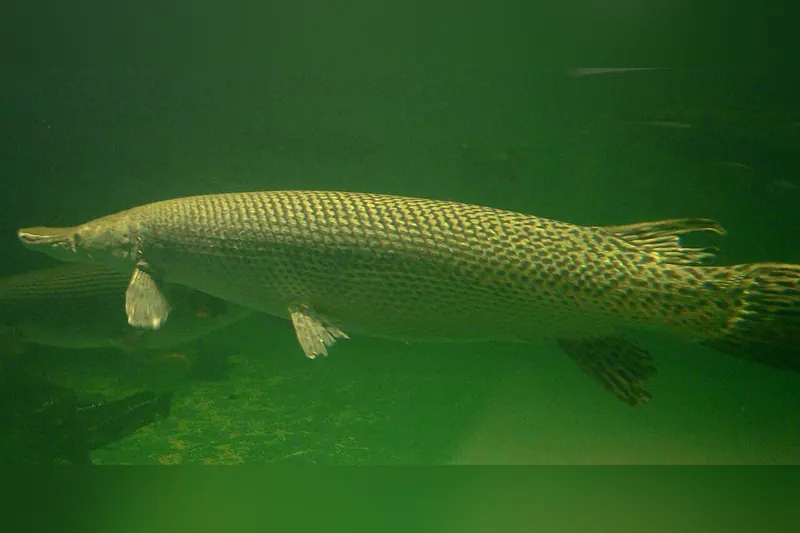
Photo: Stan Shebs, Wikimedia Commons, CC BY-SA 3.0, adjusted to 3:2
- Spawning
- In spring, once the water reaches 20 to 28 °C (68 to 82 °F) and floods spread over meadows and oxbows; spawning takes place in weedy shallows, the sticky eggs attach to vegetation and hatch within a few days; on average about 150,000 eggs per spawn (Wikipedia). Females mature only at about eleven years, males at about six (German Wikipedia).
- Typical method
- Still fishing a large fish bait at the surface or under a float in backwaters and reservoirs (rule of thumb)
- Top bait
- Whole bait fish (shad, mullet)
How to recognise it
- Long, torpedo-shaped body armored with diamond-shaped, interlocking ganoid scales (English and German Wikipedia)
- Short, broad snout and a double row of large, sharp teeth in the upper jaw (English and German Wikipedia)
- Brown to olive, belly lighter gray to yellowish, dorsal and anal fins set far back, dark blotches on all fins (Wikipedia, FishBase)
Easily confused with: Longnose gar and other gars (genus Lepisosteus): much narrower, longer snout and only one row of teeth in the upper jaw (Wikipedia on the double row as a genus feature, rule of thumb on the snout). Young alligator gar are harder to identify; the broad, short snout is the best feature (FishBase, rule of thumb).
How to catch it
Methods: Still fishing a large fish bait at the surface or under a float in backwaters and reservoirs (rule of thumb), Long leaders and a free-spool run, because the fish holds the bait crosswise for a long time (rule of thumb), Rope lures of nylon fibers that tangle in the teeth, where legal (rule of thumb), Bowfishing is legal and popular in several states (Wikipedia)
Baits: Whole bait fish (shad, mullet), Large cut bait, Carp or buffalo chunk (where legal), Nylon rope lure
In hot summers large gar are often seen breaking the surface to gulp air, especially on lakes in the southern US (Wikipedia). It hunts mainly at night (Wikipedia). Spawning closures in spring can shut down areas (TPWD).
Habitat and food
Mississippi basin from southwestern Ohio and southern Illinois to the Gulf of Mexico, along the Gulf Coast from the Econfina River in Florida to Veracruz, Mexico; adults live in sluggish pools and backwaters of large rivers, swamps, bayous and lakes, rarely in brackish and marine water (FishBase). Today mainly in the southern US into Mexico, in reservoirs, backwaters, estuaries and bays; listed as extirpated in the north of its former range (Kansas, Nebraska, Ohio, Iowa) (Wikipedia). It can breathe air through its swim bladder and so survive in oxygen-poor water (FishBase, English and German Wikipedia). Found as an introduced species in China (English and German Wikipedia).
A nocturnal ambush predator, mainly piscivorous, also a scavenger; mostly forage fish such as gizzard shad, plus invertebrates, waterfowl, turtles and small mammals; brackish-water populations eat many blue crabs (Wikipedia, FishBase). German Wikipedia also lists small alligators.
Size and age
FishBase: max. 260 cm, commonly 200 cm, maximum published weight 137 kg, maximum age 95 years. According to Wikipedia adults commonly measure 6 ft (1.8 m) and weigh over 100 lb (45 kg); the largest officially recorded fish (netted in 2011, Mississippi) was 2.572 m (8 ft 5 1/4 in) and 148 kg (327 lb), while reports of 3 m and 159 kg are anecdotal. German Wikipedia, by contrast, gives a documented length of over three meters. Rod-and-reel record according to Wikipedia: 283 lb (128.37 kg) from Sam Rayburn Lake, Texas, September 2023. Females live up to 50 years and males have been documented to 26 according to German Wikipedia.
Protection and rules
In the USA, each state sets its own size limits, bag limits and seasons. Pescaday does not list these rules yet: check them with the fish and wildlife agency of the state you fish in. Fishing licence USA: agency by state
In Germany we found no minimum size or closed season for this species in any state fisheries regulation.
In the kitchen
High yield of white fillets with little waste; in the southern US popular as fried gar balls, grilled fillets or boiled in crab boil (Wikipedia). Warning: the bright red roe is poisonous to humans (Wikipedia). Raised in aquaculture in Mexico and Cuba (English and German Wikipedia).
Sources (5)
- fishbase.de/summary/Atractosteus-spatula.html
- en.wikipedia.org/wiki/Alligator_gar
- de.wikipedia.org/wiki/Alligatorhecht
- api.gbif.org/v1/species/2346754/vernacularNames
- tpwd.texas.gov/regulations/outdoor-annual/fishing/freshwater-fishing/b
Last checked 2026-10-22. Found a mistake? Write to [email protected].
Know more?
Additions, photos of your catches or a mistake in the text: write to us and we will gladly credit you as a helper.
Send a tip