Species
Atlantic salmon
A migratory fish that grows up at sea and travels far up rivers to spawn; critically endangered in Germany and the target of large reintroduction projects.
Salmo salar
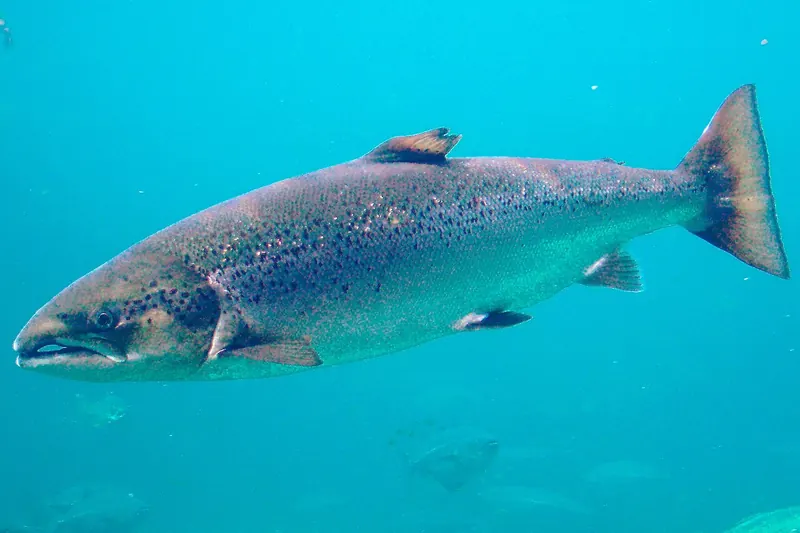
Photo: Hans-Petter Fjeld, Wikimedia Commons, CC BY-SA 2.5, adjusted to 3:2
- Spawning
- Upstream run from late autumn, spawning over gravel in the upper reaches (general guide, varies by region)
- German Red List
- critically endangered (vom Aussterben bedroht)
- Typical method
- Fly fishing
- Top bait
- Salmon fly
How to recognise it
- Spindle-shaped, silvery blue body with a white belly
- Black spots mostly above the lateral line, tail fin usually unspotted
- Mouth reaches only to about below the rear edge of the eye, adipose fin without a black margin (FishBase)
Easily confused with: Easily confused with the sea trout: in the salmon the mouth ends roughly below the rear edge of the eye and the tail fin is usually unspotted; the sea trout has a mouth reaching behind the eye and a thicker tail stalk.
How to catch it
Methods: Fly fishing, Lure fishing (spinning) in rivers
Baits: Salmon fly, Spoon, Spinner, Plug (crankbait)
During the upstream run; in Germany it is generally not a target species because of its protected status.
Habitat and food
Grows up in the Atlantic and spawns over gravel in rivers of Europe and North America. In Germany the Rhine was once the most important salmon river; today, thanks to stocking, it occurs again here and there in the Rhine system and the Elbe (Wikipedia).
When young, mainly larvae of caddisflies, blackflies, mayflies and stoneflies; as adults at sea larger prey such as squid, sand eels, crustaceans and sometimes herring (Wikipedia).
Size and age
After two years at sea on average 71 to 76 cm and 3.6 to 5.4 kg, up to 1.5 m long (Wikipedia). FishBase: max. 150 cm, heaviest published weight 46.8 kg, maximum age 13 years.
Protection and rules
Atlantic salmon: closed season and minimum size by German state
- Baden-Württembergprotected all year
- Bavariaprotected all year only in some waters
- Berlinprotected all year
- Brandenburgprotected all yearminimum size 60 cm · closed season 16.10. to 15.04. only in some waters
- Bremenminimum size 60 cm · closed season 15.10. to 15.03. only in some waters
- Hamburgprotected all year
- Hesseprotected all year
- Mecklenburg-Western Pomeraniaminimum size 60 cm · closed season 01.09. to 31.03.minimum size 60 cm · closed season 15.09. to 14.12. (coast) only in some watersminimum size 60 cm · closed season 01.06. to 15.09. (coast) only in some waters
- Lower Saxonyprotected all year · minimum size 50 cm · closed season 15.10. to 15.03. only in some watersminimum size 60 cm · closed season 01.10. to 15.03. (coast)
- North Rhine-Westphaliaprotected all year
- Rhineland-Palatinateprotected all yearprotected all year only in some waters
- Saarlandprotected all yearprotected all year only in some waters
- Saxonyminimum size 60 cm · closed season 01.10. to 30.04.
- Saxony-Anhaltprotected all year
- Schleswig-Holsteinminimum size 60 cm · closed season 01.10. to 28.02.minimum size 60 cm · closed season 01.10. to 31.12. (coast) only in some waters
- Thuringiaprotected all year
- EU law (coast)protected all year only in some waters
From the official state fisheries regulations, retrieved 2026-10-11. All rules by state
Closed seasons and minimum sizes are set by each German state and can be stricter for single waters. All rules by state, with the legal source
In the kitchen
Fatty, reddish flesh, fried, grilled, cured or smoked; FishBase lists the salmon as an important species in commercial fisheries and aquaculture.
Sources (3)
- de.wikipedia.org/wiki/Atlantischer_Lachs
- fishbase.se/summary/Salmo-salar.html
- rote-liste-zentrum.de/detail/pdf/91293
Last checked 2026-10-14. Found a mistake? Write to [email protected].
Know more?
Additions, photos of your catches or a mistake in the text: write to us and we will gladly credit you as a helper.
Send a tip