Species
Common dace
A small, fast shoaling fish of clear rivers that is easily confused with chub and ide because of its typical whitefish shape.
Leuciscus leuciscus
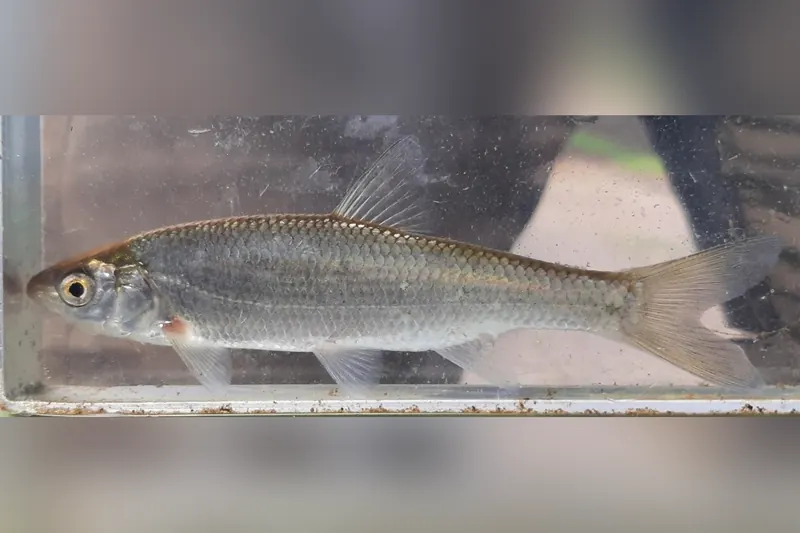
Photo: Lennart Hudel, Wikimedia Commons, CC BY 4.0, adjusted to 3:2
- Spawning
- March to April at water temperatures below 10 °C, usually at night on shallow, stony spots with current (general guide, varies by region)
- German Red List
- not threatened
- Typical method
- Float fishing
- Top bait
- Maggots
How to recognise it
- Spindle-shaped, slightly flattened body, rarely longer than 25 cm
- Small, slightly underslung mouth that does not reach the edge of the eye
- Outer edge of the dorsal and anal fins curved inwards (concave)
Easily confused with: Often confused with young chub: the chub has a wide mouth and an outward-curved anal fin, the dace a small mouth and a concave anal fin. The reddish tint of the pectoral and pelvic fins is weaker in the dace than in the chub.
How to catch it
Methods: Float fishing, Pole fishing, Fly fishing
Baits: Maggots, Bread flake, Small dry fly, Nymph
It usually feeds most intensively around dawn and dusk; the dace is shy and very fast.
Habitat and food
Mostly hard-bottomed rivers from the trout to the barbel zone, also river lakes and reservoirs, more rarely still waters. It prefers clear water in calmer or slow-flowing sections; widespread in Germany, becoming rarer towards the north.
Mainly aquatic invertebrates, larvae and algae, plus insects falling onto the water and occasionally water plants or seeds of bank plants.
Size and age
Rarely more than 25 cm; average life expectancy 10 years, under optimal conditions up to 16 years (Wikipedia). FishBase: max. 40 cm, heaviest published weight 1.0 kg, maximum age 16 years.
Protection and rules
Common dace: closed season and minimum size by German state
- Bavariaclosed season 01.03. to 30.04.
- Berlinminimum size 15 cm
- Brandenburgminimum size 15 cm
- Hamburgprotected all year
- Mecklenburg-Western Pomeraniaclosed season 01.03. to 31.05.
- Rhineland-Palatinateminimum size 15 cm
- Schleswig-Holsteinprotected all year
- Thuringiaminimum size 20 cm · closed season 01.04. to 31.05.
From the official state fisheries regulations, retrieved 2026-10-11. All rules by state
Closed seasons and minimum sizes are set by each German state and can be stricter for single waters. All rules by state, with the legal source
In the kitchen
Of little economic importance in Europe; it is eaten in some parts of Europe but is not highly regarded as a food fish (English Wikipedia).
Sources (4)
- de.wikipedia.org/wiki/Hasel_(Fisch)
- fishbase.se/summary/Leuciscus-leuciscus.html
- rote-liste-zentrum.de/detail/pdf/91238
- en.wikipedia.org/wiki/Common_dace
Last checked 2026-10-13. Found a mistake? Write to [email protected].
Know more?
Additions, photos of your catches or a mistake in the text: write to us and we will gladly credit you as a helper.
Send a tip