Species
Tarpon
Atlantic tarpon, "silver king". The "silver king" of the tropics: a huge, silver-armored fish that leaps head-high in the fight and is almost always released in Florida, Belize, Costa Rica and Cuba.
Megalops atlanticus
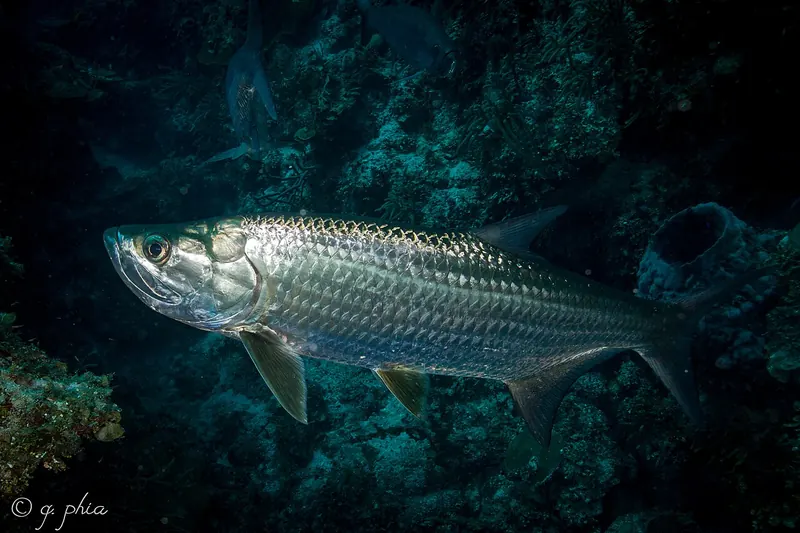
Photo: q phia, Wikimedia Commons, CC BY 2.0, adjusted to 3:2
- Spawning
- Spawns at sea in large aggregations; the sources give no season. The leptocephalus larvae drift into estuaries and swamps, juveniles leave these backwaters at about three years and mature at about eight (Wikipedia). A 2.03 m female carried 12 million eggs (German Wikipedia).
- Typical method
- Fly fishing on the flats and in channels
- Top bait
- Live mullet
How to recognise it
- Very large silver scales, back greenish to bluish
- Upturned mouth, lower jaw with an elongated bony plate
- Last dorsal fin ray drawn out into a filament reaching almost to the tail
Easily confused with: Hard to confuse. The Indo-Pacific tarpon (Megalops cyprinoides) is the only other species in the family and lives only in the Indo-Pacific (German Wikipedia). Small tarpon resemble bonefish but have the upturned mouth and the dorsal filament.
How to catch it
Methods: Fly fishing on the flats and in channels, Drifting live baitfish or crabs, Casting big soft plastics and plugs at bridges and passes, Night fishing at lit bridges (rule of thumb)
Baits: Live mullet, Live crab, Shrimp, Large soft plastic, Tarpon streamer (fly)
Tarpon prefer 22 to 28 °C and turn sluggish below 16 °C (Wikipedia), so the warm half of the year is the main season in Florida and the Caribbean; ask local guides for the exact months (rule of thumb).
Habitat and food
Western Atlantic from Nova Scotia and Bermuda to Brazil including the Gulf of Mexico and Caribbean, eastern Atlantic from Mauritania to Angola (FishBase). Coastal waters, bays, mangrove lagoons and rivers, usually 0 to 15 m deep; some populations live entirely in fresh water, for example in the Rio San Juan and Lake Nicaragua (FishBase, Wikipedia). Tarpon gulp air into the swim bladder and so tolerate oxygen-poor water. Schools have migrated through the Panama Canal for over 80 years, and Pacific populations exist off Panama and Costa Rica (English and German Wikipedia).
Adults eat schooling fish such as sardines, anchovies, mullet and snook, plus crabs and shrimp; juveniles eat zooplankton and small prey (FishBase, Wikipedia).
Size and age
FishBase: max. 250 cm, commonly around 130 cm, maximum published weight 161 kg, maximum age 55 years. Males rarely exceed 100 lb (45 kg) according to Wikipedia. IGFA all-tackle record according to Game and Fish Magazine: 286 lb 9 oz (about 130 kg) from Guinea-Bissau, 2003; we could not access the IGFA database itself (members only).
Protection and rules
Size limits, bag limits, seasons and licences are set by each country, in the USA by each state. Pescaday does not list these rules: check them with your operator and the national authority before you fish. Notes with sources are given above under conservation status. Licence pages: Mexico, Belize, Costa Rica, Panama, USA. Fishing travel guide
In the kitchen
The flesh is considered undesirable and bony and is rarely eaten in the USA; in some countries it is sold fresh or salted, and Colombia farms tarpon (English and German Wikipedia). In the sport fisheries catch and release is the standard.
Sources (8)
- fishbase.se/summary/Megalops-atlanticus.html
- en.wikipedia.org/wiki/Atlantic_tarpon
- de.wikipedia.org/wiki/Atlantischer_Tarpun
- bonefishtarpontrust.org/blog/2013-06-13-fwc-approves-bonefish-and-tarp
- myfwc.com/fishing/saltwater/recreational/tarpon/
- coastalzonebelize.org/wp-content/uploads/2019/09/Sport-fishing-Brochur
- dof.gob.mx/normasOficiales/5256/sagarpa12_C/sagarpa12_C.html
- incopesca.go.cr/acerca_incopesca/normativa/ley_de_pesca_y_acuicultura_
Last checked 2026-10-19. Found a mistake? Write to [email protected].
Know more?
Additions, photos of your catches or a mistake in the text: write to us and we will gladly credit you as a helper.
Send a tip