Species
Sailfish
Indo-Pacific sailfish. The sail of the tropics: a billfish with a giant dorsal fin, caught in record numbers off Costa Rica, Guatemala and Panama and almost always released.
Istiophorus platypterus
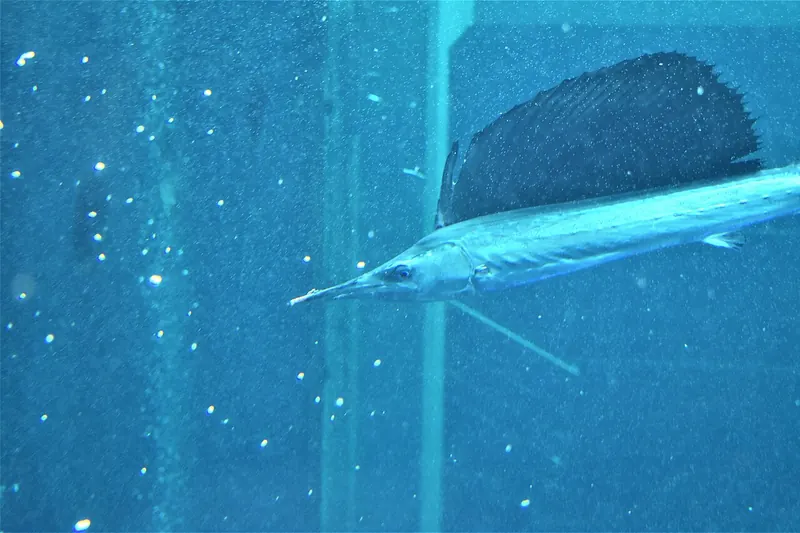
Photo: 出羽雀台, Wikimedia Commons, CC BY-SA 4.0, adjusted to 3:2
- Spawning
- Mainly in the local summer but possible year round, in shallow coastal water, usually in pairs or one female with two or three males; a 33.4 kg female carried 4.8 million eggs released in three batches (German Wikipedia).
- Typical method
- Trolling ballyhoo on circle hooks (rule of thumb, the standard in Costa Rica and Guatemala)
- Top bait
- Ballyhoo
How to recognise it
- Upper jaw drawn out into a long round spear
- First dorsal fin enlarged into a huge sail, dark blue with black spots, tallest in the middle
- Very long narrow pelvic fins; back dark blue, sides brownish blue, belly silvery white
Easily confused with: Marlin have a much lower dorsal fin; the swordfish has a flat broad bill and no pelvic fins. The sail is unmistakable (German Wikipedia).
How to catch it
Methods: Trolling ballyhoo on circle hooks (rule of thumb, the standard in Costa Rica and Guatemala), Hookless teaser spread and bait and switch (rule of thumb), Fly fishing behind teasers with a 12 to 14 weight (rule of thumb), Live bait on a kite (rule of thumb)
Baits: Ballyhoo, Skirted trolling lure, Large popper fly, Live bonito or goggle-eye
Costa Rica Pacific: December to April, Guatemala similar, Panama year round with peaks (rule of thumb from travel offers, not official). Water from 21 °C (German Wikipedia).
Habitat and food
Tropical and temperate waters of the Indo-Pacific, highly migratory, 0 to 200 m, usually above the thermocline (FishBase). Prefers 21 to 28 °C, often near coasts and islands; groups of up to 30 fish, hunting packs up to 70 (German Wikipedia). The Atlantic form (Istiophorus albicans) is treated as a synonym by many authors, FishBase lists it separately (max. 315 cm, 58.1 kg).
Small schooling fish such as sardines, mackerel and halfbeaks, plus crustaceans and squid; larvae eat copepods first, then fish larvae (German Wikipedia, FishBase).
Size and age
FishBase: max. 348 cm, commonly around 270 cm, maximum published weight 100.2 kg, maximum age 13 years. German Wikipedia gives usually about 2.5 m, max. 3.80 m and 50 to 100 kg; the largest fish are females. Pacific record fish according to Sport Fishing Magazine: 221 lb (100.2 kg) from Santa Cruz Island, Ecuador, 1947; IGFA database not accessed. Older speed claims of 75 to 110 km/h are outdated, newer studies give at most 36 km/h (German Wikipedia).
Protection and rules
Size limits, bag limits, seasons and licences are set by each country, in the USA by each state. Pescaday does not list these rules: check them with your operator and the national authority before you fish. Notes with sources are given above under conservation status. Licence pages: Mexico, Belize, Costa Rica, Panama, USA. Fishing travel guide
In the kitchen
Edible, also used for sashimi and sushi (German Wikipedia), but valued less than marlin (Wikipedia). Sport anglers almost always release it; in Costa Rica it may only be transported domestically with a special permit (Tico Times 2023).
Sources (8)
- fishbase.se/summary/Istiophorus-platypterus.html
- fishbase.se/summary/Istiophorus-albicans.html
- de.wikipedia.org/wiki/F%C3%A4cherfisch
- en.wikipedia.org/wiki/Indo-Pacific_sailfish
- incopesca.go.cr/acerca_incopesca/normativa/ley_de_pesca_y_acuicultura_
- ticotimes.net/2023/03/09/costa-ricas-new-sailfish-ruling-conservation-
- dof.gob.mx/normasOficiales/5256/sagarpa12_C/sagarpa12_C.html
- sportfishingmag.com/top-100-world-record-fish
Last checked 2026-10-19. Found a mistake? Write to [email protected].
Know more?
Additions, photos of your catches or a mistake in the text: write to us and we will gladly credit you as a helper.
Send a tip