Species
Permit
The hardest fish on the flats: deep-bodied, silver, with sickle-shaped fins and a taste for crabs. Catch a bonefish, a tarpon and a permit in one day and you have the "grand slam".
Trachinotus falcatus
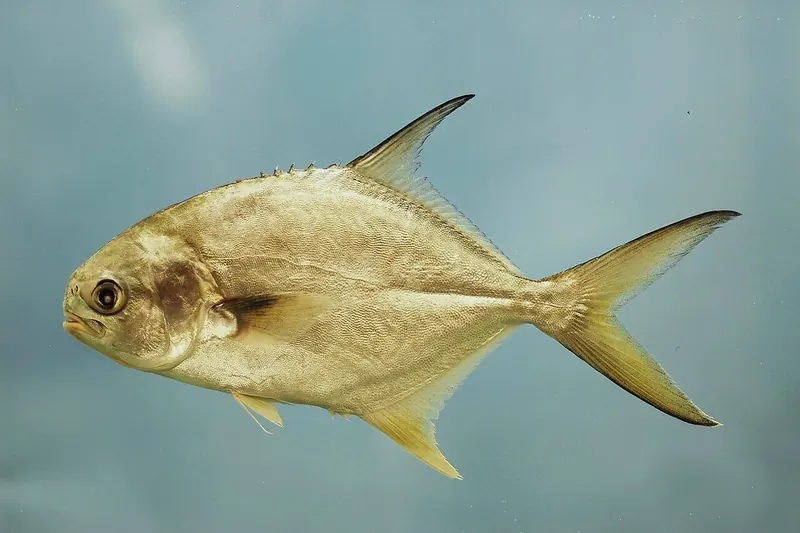
Photo: SEFSC Pascagoula Laboratory; Collection of Brandi Noble, NOAA/NMFS/SEFSC., Wikimedia Commons, Public domain, adjusted to 3:2
- Spawning
- Spawns offshore in open water (FishBase, Wikipedia); our sources give no season.
- Typical method
- Sight casting crab flies on the flats
- Top bait
- Live crab
How to recognise it
- Deep, strongly compressed body, narrow seen head-on
- Dorsal and anal fins with dark sickle-shaped front lobes, deeply forked tail, no scutes on the lateral line
- Large orange-yellow patch on the belly in front of the anal fin, dark pectoral fins
Easily confused with: Florida pompano (Trachinotus carolinus) and palometa (T. goodei) look similar, especially as juveniles. Reliable permit marks are the orange-yellow belly patch and the dark front lobes of the fins (Wikipedia). The genus has 20 species (German Wikipedia).
How to catch it
Methods: Sight casting crab flies on the flats, Drifting live crabs over wrecks and reefs, Light spinning with a jig and shrimp along channel edges
Baits: Live crab, Crab fly, Shrimp, Jig with shrimp imitation
On the flats on a rising tide, when the sickle-shaped tail tips show as the fish root in the bottom; offshore over wrecks year round (rule of thumb from travel offers). In south Florida harvest is closed from May to July (see rules).
Habitat and food
Western Atlantic from Massachusetts to southeastern Brazil including the Bahamas and many West Indian islands; reports from Africa are misidentifications (FishBase). Adults in channels and holes, over sand flats and around reefs, usually 0 to 30 m, solitary or in small groups; juveniles in the surf zone (FishBase, Wikipedia).
Adults eat mollusks, crabs, shrimp and small fish, juveniles benthic invertebrates (FishBase).
Size and age
FishBase: max. 122 cm, commonly around 94 cm, maximum published weight 36 kg, maximum age 23 years. Record fish according to Sport Fishing Magazine: 60 lb (27.2 kg) from Paranagua, Brazil, 2002; IGFA database not accessed.
Protection and rules
Size limits, bag limits, seasons and licences are set by each country, in the USA by each state. Pescaday does not list these rules: check them with your operator and the national authority before you fish. Notes with sources are given above under conservation status. Licence pages: Mexico, Belize, Costa Rica, Panama, USA. Fishing travel guide
In the kitchen
Excellent food fish (FishBase). On the flats of Belize, Mexico and Cuba it is released as a rule, in Belize by law.
Sources (7)
- fishbase.se/summary/Trachinotus-falcatus.html
- en.wikipedia.org/wiki/Permit_(fish)
- de.wikipedia.org/wiki/Trachinotus
- myfwc.com/fishing/saltwater/recreational/permit/
- saltwatersportsman.com/?p=46961
- coastalzonebelize.org/wp-content/uploads/2019/09/Sport-fishing-Brochur
- bahamas.com/fishing-faq
Last checked 2026-10-19. Found a mistake? Write to [email protected].
Know more?
Additions, photos of your catches or a mistake in the text: write to us and we will gladly credit you as a helper.
Send a tip