Species
Bonefish
The "grey ghost" of the flats: silver, wary and blisteringly fast. On the sand flats of the Bahamas, Belize, Cuba and Mexico it is the top discipline of fly fishing, almost everywhere catch and release only.
Albula vulpes
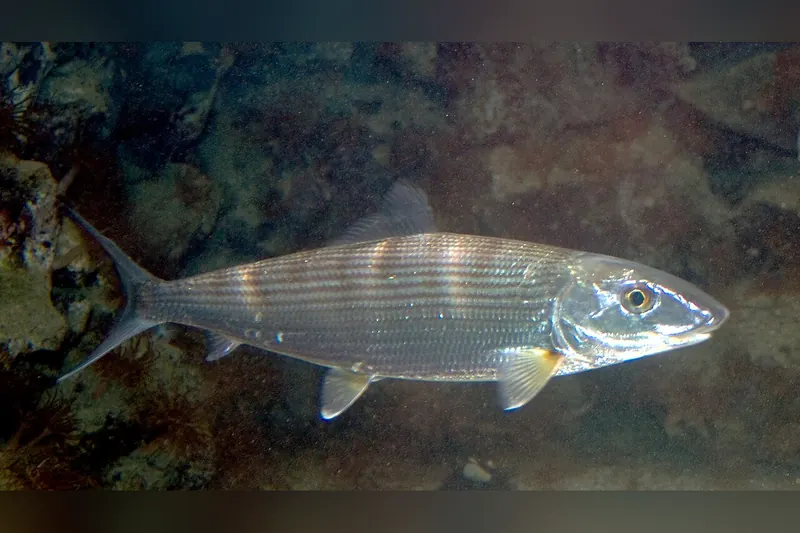
Photo: Brian Gratwicke, Wikimedia Commons, CC BY 2.0, adjusted to 3:2
- Spawning
- Spawns in open water with pelagic eggs (FishBase); larvae drift for an average of 53 days, maturity at 2 to 3 years from about 43 cm (Wikipedia). Our sources give no season.
- Typical method
- Sight casting with a fly rod while wading or from a flats skiff (Wikipedia)
- Top bait
- Shrimp fly (for example Gotcha, Crazy Charlie)
How to recognise it
- Silver sides, back olive green to silver, often with faint dark lengthwise lines
- Underslung mouth, the snout projects beyond the mouth
- Slim round body with a deeply forked tail
Easily confused with: Juvenile tarpon and ladyfish look similarly silver but have an upturned mouth; the bonefish has the mouth underneath. The 11 Albula species are hard to tell apart externally (Wikipedia).
How to catch it
Methods: Sight casting with a fly rod while wading or from a flats skiff (Wikipedia), Light spinning with small jigs, Shrimp or crab on a light bottom rig (rule of thumb)
Baits: Shrimp fly (for example Gotcha, Crazy Charlie), Crab fly, Small jig, Live shrimp
On the incoming tide on the flats, when tails stick out of the water as the fish feed (Wikipedia). Calm, clear days make sight fishing easier (rule of thumb).
Habitat and food
Warm western Atlantic from North Carolina to Brazil including the Gulf of Mexico and Caribbean (FishBase; the Pacific and Hawaiian forms are now treated as separate species, 11 species in all). Shallow coastal waters, bays and estuaries over sand and mud, 0 to 84 m, usually 1 to 15 m (FishBase). Moves onto mud and sand flats with the incoming tide and holds at seagrass edges and drop-offs (Wikipedia). Can gulp air into the swim bladder (FishBase).
Roots in the bottom for worms, crustaceans and mollusks; on seagrass mainly crabs and shrimp, at Los Roques also glass minnows (FishBase, Wikipedia).
Size and age
The sources differ: FishBase gives max. 104 cm and 10.0 kg, Wikipedia up to 79 cm and 7.7 kg; lifespan up to 20 years (Wikipedia). Record fish according to Sport Fishing Magazine: 19 lb (8.6 kg) from Zululand, South Africa, 1962, so an African Albula form; IGFA database not accessed.
Protection and rules
Size limits, bag limits, seasons and licences are set by each country, in the USA by each state. Pescaday does not list these rules: check them with your operator and the national authority before you fish. Notes with sources are given above under conservation status. Licence pages: Mexico, Belize, Costa Rica, Panama, USA. Fishing travel guide
In the kitchen
Eaten in less developed areas, in the Bahamas traditionally split, seasoned with pepper sauce and salt and baked (Wikipedia). In the sport fisheries almost exclusively catch and release, mandatory in Florida and Belize.
Sources (7)
- fishbase.se/summary/Albula-vulpes.html
- en.wikipedia.org/wiki/Bonefish
- de.wikipedia.org/wiki/Gr%C3%A4tenfische
- bonefishtarpontrust.org/blog/2013-06-13-fwc-approves-bonefish-and-tarp
- myfwc.com/fishing/saltwater/recreational/bonefish/
- coastalzonebelize.org/wp-content/uploads/2019/09/Sport-fishing-Brochur
- bahamas.com/fishing-faq
Last checked 2026-10-19. Found a mistake? Write to [email protected].
Know more?
Additions, photos of your catches or a mistake in the text: write to us and we will gladly credit you as a helper.
Send a tip