Species
European sea bass
A silvery coastal predator that hunts right into the surf and into estuaries in summer; still rare on the German coast, but increasing.
Dicentrarchus labrax
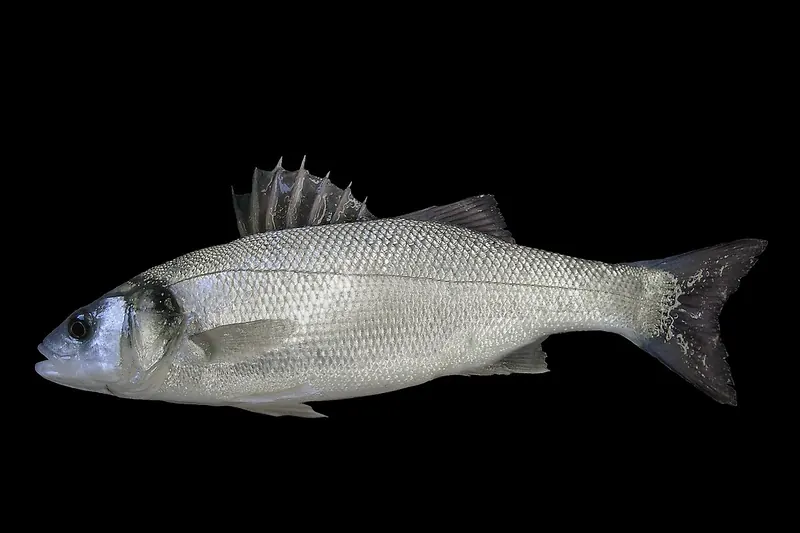
Photo: Hans Hillewaert, Wikimedia Commons, CC BY-SA 4.0, adjusted to 3:2
- Spawning
- Winter to spring, mating from January to March (general guide, varies by region)
- German Red List
- not threatened
- Typical method
- Lure fishing (spinning) from the shore and groynes
- Top bait
- Hard lures and surface lures
How to recognise it
- Elongated body, dark grey back, silvery flanks and an almost white belly
- Clearly visible dark lateral line
- Two dorsal fins, the front one with hard spines; gill cover with two flat spines
Easily confused with: Young sea bass have a few dark spots on the upper body (FishBase). Grey mullets are also silvery and have two dorsal fins, but they have a small mouth with thick lips and dark lengthwise stripes instead of a large predator's mouth.
How to catch it
Methods: Lure fishing (spinning) from the shore and groynes, Saltwater fly fishing from the shore, Bottom fishing in the surf and in estuaries
Baits: Hard lures and surface lures, Soft plastic fish, Ragworm, Prawn or crab, Fish strips
Summer to autumn, when the fish hunt close to the coast and in estuaries; especially at dusk and at night.
Habitat and food
Eastern Atlantic from Morocco to Norway, the Mediterranean and the Black Sea, most common around the British Isles and in the North Sea. Lives at depths of 10 to 100 m but hunts in water as shallow as knee depth; in summer also in the brackish water of estuaries, in the cold season offshore in deep water (Wikipedia).
Hunts mainly at night for molluscs, crustaceans and fish (Wikipedia); juveniles eat invertebrates and take more and more fish as they grow (FishBase).
Size and age
Up to about 1 m and approx. 12 kg (Wikipedia). FishBase: max. 103 cm, common length 50 cm, max. published weight 12.0 kg, max. reported age 30 years.
Protection and rules
European sea bass: closed season and minimum size by German state
- Schleswig-Holsteinminimum size 42 cm (coast)
- EU law (coast)minimum size 42 cm · closed season 01.02. to 31.03.
From the official state fisheries regulations, retrieved 2026-10-11. All rules by state
Closed seasons and minimum sizes are set by each German state and can be stricter for single waters. All rules by state, with the legal source
In the kitchen
Fine, white, mild flesh; grilled whole, baked in a salt crust or as a pan-fried fillet (Fisch-Informationszentrum).
Sources (6)
- de.wikipedia.org/wiki/Europäischer_Wolfsbarsch
- fishbase.se/summary/Dicentrarchus-labrax.html
- rote-liste-zentrum.de/detail/pdf/224919
- eur-lex.europa.eu/eli/reg/2026/249/oj
- fischinfo.de/wp-content/uploads/2025/06/FIZ-Fischlexikon_Wolfsbarsch_w
- en.wikipedia.org/wiki/European_seabass
Last checked 2026-10-13. Found a mistake? Write to [email protected].
Know more?
Additions, photos of your catches or a mistake in the text: write to us and we will gladly credit you as a helper.
Send a tip