Species
European smelt
A small, silvery shoaling fish that migrates into the lower reaches of rivers to spawn, smells of cucumber and is a fried speciality in northern Germany.
Osmerus eperlanus
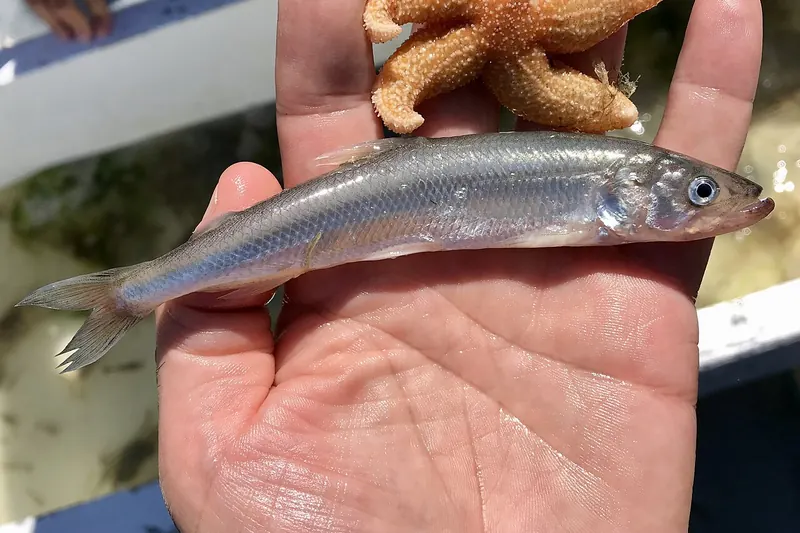
Photo: Nasser Halaweh, Wikimedia Commons, CC BY 4.0, adjusted to 3:2
- Spawning
- End of February to March, when the water is warmer than 9 °C (Wikipedia; general guide, varies by region)
- German Red List
- endangered (stark gefährdet)
- Typical method
- Herring paternoster (sabiki) in harbours
- Top bait
- Herring paternoster (sabiki)
How to recognise it
- Slim, slightly translucent body with shiny silver flanks
- Small adipose fin, lower jaw slightly protruding, tail fin with a dark edge
- Strong smell of fresh cucumber, hence also called cucumber fish
Easily confused with: Looks like small herring or bleak; the smelt, however, has an adipose fin and the typical cucumber smell (Wikipedia).
How to catch it
Methods: Herring paternoster (sabiki) in harbours, Fine float fishing
Baits: Herring paternoster (sabiki), Small strip of fish, Maggot
In autumn smelt come into the harbours on the North Sea coast, where they are caught with a herring paternoster (Wikipedia).
Habitat and food
Coastal waters of Europe from the Baltic Sea to the Bay of Biscay; to spawn it moves into the lower reaches of large rivers. A freshwater form lives in large lakes of northern Europe (Wikipedia).
Mainly small planktonic crustaceans, bottom-dwelling animals and also young fish of its own species (Wikipedia).
Size and age
Usually 10 to 18 cm, on average 15 cm, at most 30 cm; lives up to six years (Wikipedia). FishBase, on the other hand, gives max. 45 cm, a heaviest published weight of 178 g and a maximum age of 10 years.
Protection and rules
European smelt: closed season and minimum size by German state
- Berlinclosed season 01.02. to 30.04.
- Brandenburgprotected all year
- Mecklenburg-Western Pomeraniaclosed season 01.03. to 30.04.
From the official state fisheries regulations, retrieved 2026-10-11. All rules by state
Closed seasons and minimum sizes are set by each German state and can be stricter for single waters. All rules by state, with the legal source
In the kitchen
Head off, the tail and the soft bones are eaten too; traditionally coated in rye flour and fried in butter and bacon, served with fried potatoes, potato salad and apple sauce. Also smoked or pickled (Wikipedia).
Sources (3)
- de.wikipedia.org/wiki/Stint
- fishbase.se/summary/Osmerus-eperlanus.html
- rote-liste-zentrum.de/detail/pdf/91253
Last checked 2026-10-13. Found a mistake? Write to [email protected].
Know more?
Additions, photos of your catches or a mistake in the text: write to us and we will gladly credit you as a helper.
Send a tip