Species
Turbot
An almost circular flatfish with both eyes on the left side and stone-like bony knobs; a highly esteemed food fish.
Scophthalmus maximus
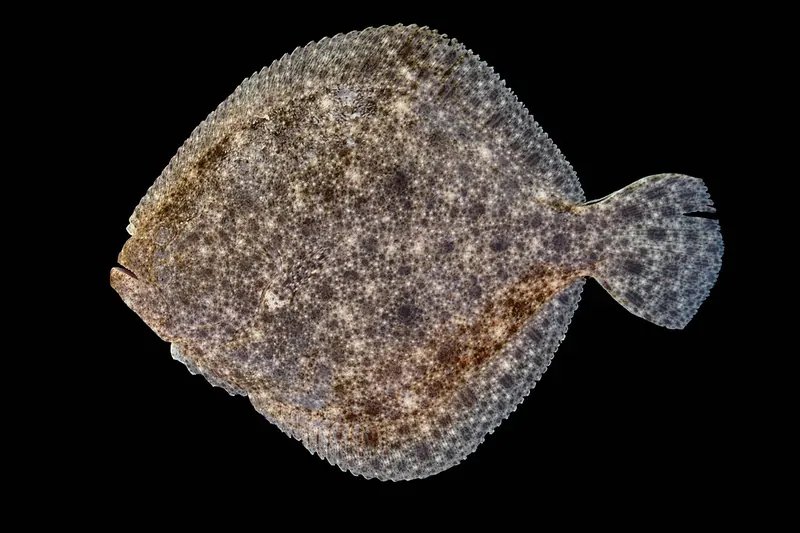
Photo: Hans Hillewaert, Wikimedia Commons, CC BY-SA 3.0, adjusted to 3:2
- Spawning
- In the North Sea area April to August (general guide, varies by region)
- German Red List
- not threatened
- Typical method
- Surf fishing
- Top bait
- Sand eel
How to recognise it
- Almost circular body, both eyes on the left side
- Upper side without scales but with large bony knobs that look like small stones
- Upper side matches the colour of the seabed, underside white
Easily confused with: Looks like its close relative the brill, which is oval and has smooth scales instead of bony knobs. Plaice, flounder and dab have their eyes on the right side.
How to catch it
Methods: Surf fishing, Drift fishing from a boat over sandy ground, Bottom fishing with fish strips
Baits: Sand eel, Fish strips, Ragworm, Small soft plastic fish
In summer during spawning, when the fish are in shallower water; over sand and gravel.
Habitat and food
European Atlantic coasts, the Mediterranean, North Sea and Baltic Sea, on sand and gravel at 20 to 70 m depth (Wikipedia); on sandy, rocky or mixed ground and rather common in brackish water (FishBase). Young turbot grow up in shallow coastal waters.
Mainly small bottom-living fish such as sand eels and gobies, fewer crustaceans and molluscs (Wikipedia, FishBase).
Size and age
On average 50 to 70 cm, more rarely up to 1 m and then over 20 kg (Wikipedia). FishBase: max. 100 cm (standard length), max. published weight 25.0 kg, max. reported age 25 years.
Protection and rules
Turbot: closed season and minimum size by German state
- Mecklenburg-Western Pomeraniaminimum size 30 cm (coast)
- Lower Saxonyminimum size 30 cm (coast)
- Schleswig-Holsteinminimum size 30 cm (coast)minimum size 30 cm · closed season 01.06. to 31.07. (coast)
From the official state fisheries regulations, retrieved 2026-10-11. All rules by state
Closed seasons and minimum sizes are set by each German state and can be stricter for single waters. All rules by state, with the legal source
In the kitchen
Firm, white and highly prized flesh; steamed, pan-fried, boiled or baked (FishBase).
Sources (5)
- de.wikipedia.org/wiki/Steinbutt
- fishbase.se/summary/Scophthalmus-maximus.html
- rote-liste-zentrum.de/detail/pdf/225072
- de.wikipedia.org/wiki/Glattbutt
- en.wikipedia.org/wiki/Turbot
Last checked 2026-10-13. Found a mistake? Write to [email protected].
Know more?
Additions, photos of your catches or a mistake in the text: write to us and we will gladly credit you as a helper.
Send a tip