Species
Round goby
An introduced goby from the Black Sea region that has spread massively in the Rhine, Danube, Elbe and along the Baltic coast and is often the first fish on the bait.
Neogobius melanostomus
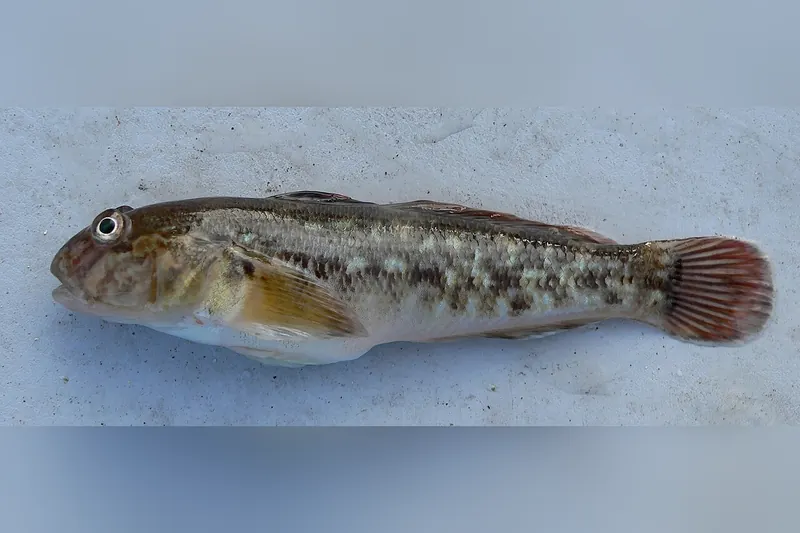
Photo: Viridiflavus, Wikimedia Commons, CC BY-SA 3.0, adjusted to 3:2
- Spawning
- April to September, females spawn several times; the male guards the eggs under stones (Wikipedia; general guide, varies by region)
- German Red List
- not assessed
- Typical method
- Ledgering with a small hook
- Top bait
- Redworm
How to recognise it
- Roundish, elongated body with brownish pattern, white underside; bulging eyes on top of the head
- Two dorsal fins, the front one with a striking black eye spot
- Pelvic fins fused into a suction disc; males almost black in the spawning season
Easily confused with: Resembles other introduced gobies such as the bighead goby or monkey goby; typical of the round goby is the large black spot at the rear of the first dorsal fin (FishBase).
How to catch it
Methods: Ledgering with a small hook, Float fishing near the bottom, Feeder or coarse fishing (often as bycatch)
Baits: Redworm, Piece of lobworm, Maggot, Small soft plastic
From spring into autumn along rock embankments near the bank; in cold water populations are much smaller (Wikipedia).
Habitat and food
Originally the brackish waters of the Black, Azov and Caspian Seas; today in the Rhine, Main, Moselle, Neckar, Danube, Elbe, Oder, Trave and along the Baltic coast. Lives near the bottom in shallow margins down to about 3 m, especially on rock embankments (Wikipedia).
When young, zooplankton; as adults mainly amphipods and insect larvae, plus water snails and small mussels; in one study fish eggs and fry made up less than 1 percent of the diet (Wikipedia).
Size and age
On average about 15 cm, old fish over 20 cm; usually 3 to 4 years old, exceptionally up to 6 years (Wikipedia). FishBase: max. 35 cm, heaviest published weight 381.42 g, maximum age 6 years.
Protection and rules
We found no minimum size or closed season for this species in any state fisheries regulation. Local water rules may still apply.
Closed seasons and minimum sizes are set by each German state and can be stricter for single waters. All rules by state, with the legal source
In the kitchen
Hardly known as food in Central Europe and fiddly to prepare because of its size; angling associations promote recipes from Eastern Europe (Wikipedia). Used as bait fish for zander and wels catfish where local rules allow it.
Sources (4)
Know more?
Additions, photos of your catches or a mistake in the text: write to us and we will gladly credit you as a helper.
Send a tip