Species
Smallmouth bass
A hard-fighting bass of clear, cool rivers and rocky lakes, also called smallie or bronzeback: bronze colored with dark vertical bars.
Micropterus dolomieu
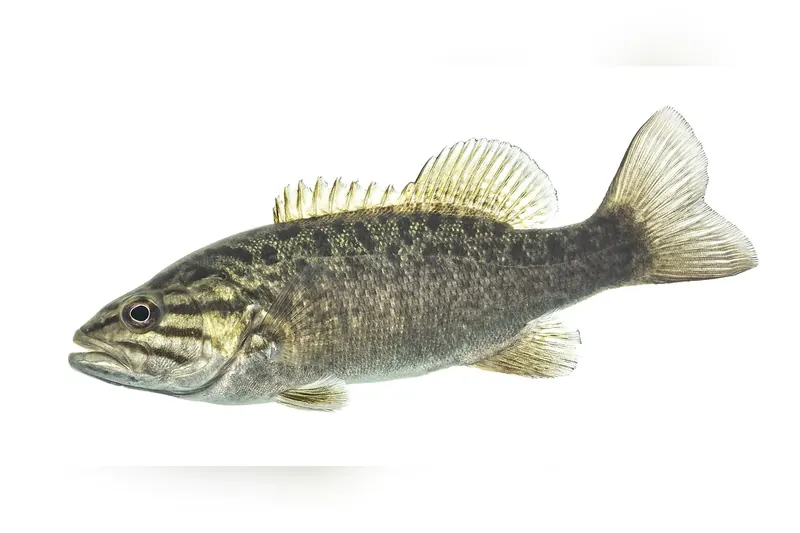
Photo: USFWS Mountain Prairie, Wikimedia Commons, Public domain, adjusted to 3:2
- Spawning
- Spring to early summer at about 59 to 64 °F (15 to 18 °C); the male builds the nest on clean gravel or rock and guards eggs and fry for up to a month (Wikipedia, TPWD; general guide, varies by region)
- Typical method
- Crankbaits, jerkbaits and spinnerbaits
- Top bait
- Tube
How to recognise it
- Golden olive to dark brown with dark vertical bars or blotches on the sides
- Jaw ends below the eye, not behind it; eye red or brown
- Spiny and soft parts of the dorsal fin separated only by a shallow notch
Easily confused with: The largemouth bass has a bigger mouth that extends past the eye, a dark horizontal stripe instead of vertical bars and a deeply notched dorsal fin (Wikipedia).
How to catch it
Methods: Crankbaits, jerkbaits and spinnerbaits, Soft plastics such as tubes and grubs on a jighead, Fly fishing with streamers, crawfish patterns or poppers
Baits: Tube, Curly tail grub, Hair jig, Crankbait, Small inline spinner, Crawfish
Spring through fall; in rivers fish hold behind rocks and in eddies. When the water drops below about 60 °F (16 °C) they move into deep pools and feed very little, so go with small lures such as hair jigs or small spinners (Wikipedia).
Habitat and food
Native to the upper and middle Mississippi basin, the St. Lawrence and Great Lakes system and the Hudson Bay basin; stocking has spread it to most U.S. states, and it has been introduced in parts of Europe. Lives in clearer, cooler water than the largemouth: streams and rivers with gravel and rock, and rocky areas of large, deep lakes; handles stronger current (Wikipedia, TPWD).
Crawfish, fish, aquatic insects, tadpoles and other amphibians; fry eat zooplankton and insect larvae, and adults also eat the young of other bass (Wikipedia).
Size and age
Males usually around 2 lb (0.9 kg), females 3 to 6 lb (1.4 to 2.7 kg) (Wikipedia). Maximum about 69 cm (27 in) and 5.4 kg (12 lb); the world record of 11 lb 15 oz (5.41 kg) came from Dale Hollow Reservoir on the Kentucky and Tennessee line in 1955 (Wikipedia). FishBase: max. 69 cm, maximum published weight 5.4 kg, maximum age 26 years.
Protection and rules
We found no minimum size or closed season for this species in any state fisheries regulation. Local water rules may still apply.
Closed seasons and minimum sizes are set by each German state and can be stricter for single waters. All rules by state, with the legal source
In the kitchen
Most U.S. anglers release smallmouth rather than keep them; smaller fish from cool water give white, firm fillets (Wikipedia).
Sources (4)
- de.wikipedia.org/wiki/Schwarzbarsch
- en.wikipedia.org/wiki/Smallmouth_bass
- fishbase.se/summary/Micropterus-dolomieu.html
- tpwd.texas.gov/huntwild/wild/species/smb/
Last checked 2026-10-15. Found a mistake? Write to [email protected].
Know more?
Additions, photos of your catches or a mistake in the text: write to us and we will gladly credit you as a helper.
Send a tip