Species
Pollack
A close relative of the saithe with a protruding lower jaw and a curved lateral line; lives around rocks, reefs and wrecks and is extremely rare in German waters.
Pollachius pollachius
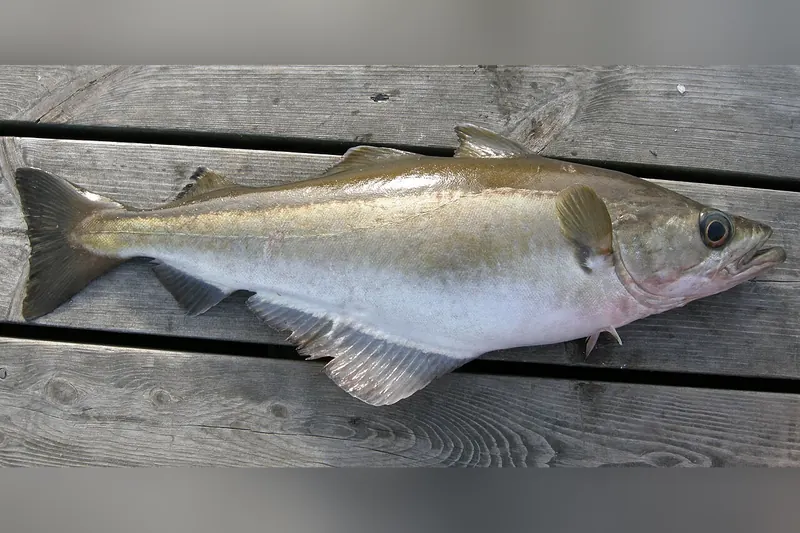
Photo: Arnstein Rønning, Wikimedia Commons, CC BY-SA 3.0, adjusted to 3:2
- Spawning
- January to May at 100 to 150 m depth at water temperatures of six to eight degrees (general guide, varies by region)
- German Red List
- extremely rare
- Typical method
- Lure fishing (spinning) on rocky coasts
- Top bait
- Soft plastic fish
How to recognise it
- Clearly protruding lower jaw, no chin barbel
- Dark lateral line with a distinct curve over the pectoral fin
- Back black, brown or olive, belly silvery grey; three dorsal and two anal fins
Easily confused with: Very similar to the saithe, which has a straight, pale lateral line and jaws of about equal length. The whiting often has a dark spot at the base of the pectoral fin, which the pollack lacks (FishBase).
How to catch it
Methods: Lure fishing (spinning) on rocky coasts, Soft plastic fishing over reefs and wrecks from a boat, Jigging with pirks
Baits: Soft plastic fish, Rubber eel, Slim pirk, Hard lure
Summer to autumn over rocky ground, reefs and wrecks, especially at dusk.
Habitat and food
Northeast Atlantic from Scandinavia and Iceland via the British Isles to Morocco, plus the North Sea, occasionally the Baltic Sea and the western Mediterranean; on the shelf in open water or near rocky bottoms down to about 200 m (Wikipedia). Juveniles stay near the coast for 2 to 3 years, larger pollack are often found around rocks at 40 to 100 m depth, also at wrecks and oil platforms (FishBase).
Mainly herring-like fish, deep-water shrimps and sand eels (Wikipedia).
Size and age
Usually about 75 cm, occasionally up to 130 cm; life expectancy about eight years (Wikipedia). FishBase: max. 130 cm, common length 75 cm, max. published weight 18.1 kg, max. reported age 8 years.
Protection and rules
We found no minimum size or closed season for this species in any state fisheries regulation. Local water rules may still apply.
Closed seasons and minimum sizes are set by each German state and can be stricter for single waters. All rules by state, with the legal source
In the kitchen
Tasty but rather dry flesh (Wikipedia); best pan-fried as a fillet or cooked in a sauce.
Sources (5)
- de.wikipedia.org/wiki/Pollack
- fishbase.se/summary/Pollachius-pollachius.html
- rote-liste-zentrum.de/detail/pdf/225043
- eur-lex.europa.eu/eli/reg/2026/249/oj
- en.wikipedia.org/wiki/Saithe
Last checked 2026-10-13. Found a mistake? Write to [email protected].
Know more?
Additions, photos of your catches or a mistake in the text: write to us and we will gladly credit you as a helper.
Send a tip