Species
Common nase
A shoaling fish of fast-flowing rivers that grazes algae off stones with its sharp, horny lower lip and has become rare in many places.
Chondrostoma nasus
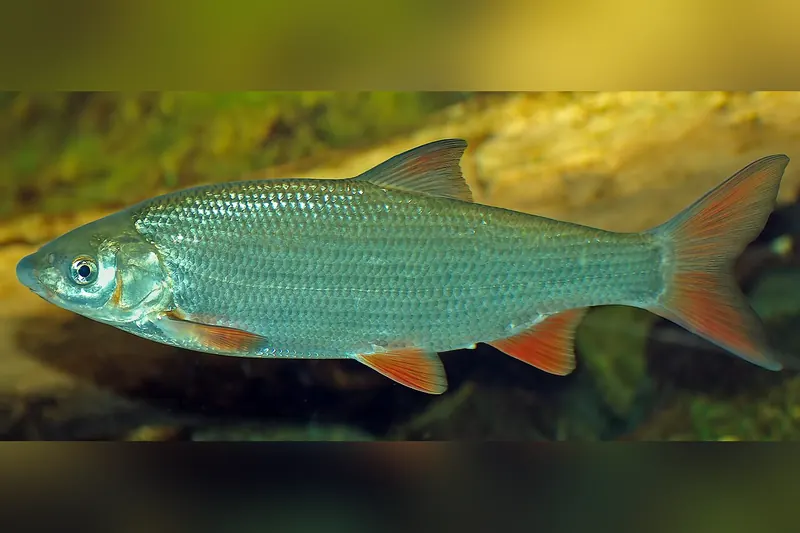
Photo: André Karwath aka Aka, Wikimedia Commons, CC BY-SA 2.5, adjusted to 3:2
- Spawning
- March to May, after spawning migrations in large shoals upriver or into side streams, over shallow gravel (general guide, varies by region)
- German Red List
- early warning list (Vorwarnliste)
- Typical method
- Float fishing
- Top bait
- Small worm
How to recognise it
- Strongly underslung mouth, the tip of the head looks like a blunt nose
- Straight, transverse mouth with a sharp-edged, horny lower lip
- Blue-grey to grey-green back, pectoral, pelvic and anal fins yellowish pink to violet
Easily confused with: Resembles the vimba bream, which also has a nose-like snout; the vimba, however, has a lower lip without a horny edge and a much longer anal fin (19 to 25 rays instead of 13 to 14).
How to catch it
Methods: Float fishing, Bottom fishing with a heavy feeder
Baits: Small worm, Caddis larva (Sprock in German), Caddis larva imitation
Not specifically documented; nase gather in shallow, fast-flowing water, often beside the swirls at bridge piers and rocks (FishBase).
Habitat and food
Fast-flowing waters of Central and Eastern Europe with sand and gravel beds in the barbel and grayling zones, for example the Rhine and Danube. In winter the adults gather in dense shoals in the lower river sections.
Grazes algae with its hard lower jaw, FishBase mainly lists diatoms and detritus; less often it eats small animals on the bottom.
Size and age
Usually 25 to 40 cm and up to 1000 g, more rarely 50 cm and 2000 g (Wikipedia). FishBase: max. 50 cm, heaviest published weight 1.5 kg, maximum age 15 years.
Protection and rules
Common nase: closed season and minimum size by German state
- Baden-Württembergminimum size 35 cm · closed season 15.03. to 31.05.
- Bavariaminimum size 30 cm · closed season 01.03. to 30.04.
- Berlinprotected all year
- Brandenburgprotected all year
- Hessekeep only from 25 to 40 cm · closed season 15.03. to 30.04.
- Mecklenburg-Western Pomeraniaprotected all year
- Lower Saxonyprotected all year · minimum size 25 cm only in some waters
- North Rhine-Westphaliaminimum size 30 cm · closed season 01.03. to 30.04.
- Rhineland-Palatinateminimum size 30 cm · closed season 15.03. to 30.04.minimum size 30 cm only in some watersminimum size 30 cm · closed season 01.03. to 14.06. only in some waters
- Saarlandminimum size 35 cm · closed season 15.03. to 15.06.minimum size 30 cm · closed season 01.03. to 14.06. only in some waters
- Saxonyminimum size 40 cm · closed season 01.01. to 15.06. only in some watersprotected all year only in some waters
- Saxony-Anhaltprotected all year
- Thuringiaprotected all year
From the official state fisheries regulations, retrieved 2026-10-11. All rules by state
Closed seasons and minimum sizes are set by each German state and can be stricter for single waters. All rules by state, with the legal source
In the kitchen
Very bony and, according to Wikipedia, not very tasty, so hardly ever sold; FishBase calls the flesh good but bony. Because the species is threatened, it is better to release it.
Sources (3)
- de.wikipedia.org/wiki/Nase_(Fisch)
- fishbase.se/summary/Chondrostoma-nasus.html
- rote-liste-zentrum.de/detail/pdf/91174
Last checked 2026-10-13. Found a mistake? Write to [email protected].
Know more?
Additions, photos of your catches or a mistake in the text: write to us and we will gladly credit you as a helper.
Send a tip