Species
European whitefish
Collective name for silvery salmonids of the genus Coregonus, called Renke, Felchen, Reinanke or Schnäpel in different German regions, which live in deep, clear lakes and are caught with a Hegene rig.
Coregonus spp.
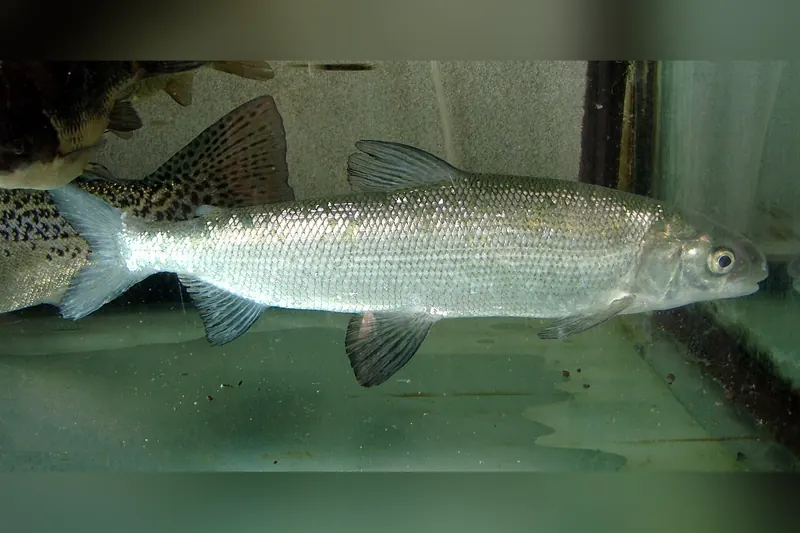
Photo: Apple2000, Wikimedia Commons, CC BY 3.0, adjusted to 3:2
- Spawning
- Late autumn to winter, depending on species and water: Lavaret in December, Baltic houting in November (Wikipedia; general guide, varies by region)
- German Red List
- Baltic houting (Coregonus maraena) endangered (stark gefährdet
- Typical method
- Hegene fishing (paternoster rig with several nymphs)
- Top bait
- Hegene rig with nymphs
How to recognise it
- Slim, silvery body with a bluish to greenish back
- Small mouth, large scales, adipose fin
- The individual species can hardly be told apart from the outside; they are identified by their gill rakers (Wikipedia)
Easily confused with: The species of the genus are hard to tell apart, and German names change from region to region (Wikipedia). The vendace (Coregonus albula) has a protruding lower jaw (English Wikipedia). It differs from the grayling by its much smaller dorsal fin (Wikipedia).
How to catch it
Methods: Hegene fishing (paternoster rig with several nymphs), Fine float fishing
Baits: Hegene rig with nymphs, Small nymph, Bloodworm
According to Wikipedia the catch of the open-water forms is traditionally limited to June and July, because in the other months they stay in deeper water.
Habitat and food
Mostly deeper lakes, such as Lake Constance, Chiemsee and other lakes at the foot of the Alps, and northern German lakes such as Müritz, Plöner See, Schaalsee, Schweriner See or Stechlinsee; some forms also live in the brackish water of the Baltic Sea, for example the Baltic houting in the Peene and Oder area (Wikipedia, Red List).
Depending on the species, plankton (open-water forms) or bottom animals (bottom-feeding forms); according to FishBase the Baltic houting eats crustaceans, molluscs, large insect larvae and small fish.
Size and age
Varies greatly by species. Baltic houting (Coregonus maraena): up to 1.20 m (Wikipedia); FishBase gives max. 130 cm, a heaviest published weight of 10.0 kg and, based on growth data from Russia, a maximum age of 20 years. Lavaret (Coregonus lavaretus): standard length 40 cm (Wikipedia); FishBase gives max. 73 cm and 10.0 kg.
Protection and rules
European whitefish: closed season and minimum size by German state
- Baden-Württembergminimum size 30 cm · closed season 15.10. to 10.01.
- Bavariaminimum size 30 cm · closed season 15.10. to 31.12.
- Berlinprotected all yearminimum size 30 cm · closed season 01.10. to 31.12. only in some waters
- Brandenburgprotected all yearminimum size 30 cm · closed season 01.10. to 31.12. only in some waters
- Bremenprotected all year
- Hamburgprotected all year
- Hesseprotected all year
- Mecklenburg-Western Pomeraniaminimum size 30 cm · closed season 01.10. to 31.12.minimum size 40 cm · closed season 01.11. to 30.11. (coast)
- Rhineland-Palatinateminimum size 25 cm
- Saxonyminimum size 30 cm · closed season 01.10. to 31.12. only in some waters
- Saxony-Anhaltminimum size 30 cm
- Schleswig-Holsteinminimum size 30 cmminimum size 40 cm · closed season 01.12. to 28.02. (coast)
From the official state fisheries regulations, retrieved 2026-10-11. All rules by state
Closed seasons and minimum sizes are set by each German state and can be stricter for single waters. All rules by state, with the legal source
In the kitchen
Tasty food fish, fried, smoked, less often boiled or steamed (Wikipedia); the Baltic houting is low in fat and is sold regionally as Ostseesteinlachs.
Sources (8)
- de.wikipedia.org/wiki/Coregonus
- de.wikipedia.org/wiki/Ostseeschnäpel
- de.wikipedia.org/wiki/Lavaret
- fishbase.se/summary/Coregonus-maraena.html
- fishbase.se/summary/Coregonus-lavaretus.html
- rote-liste-zentrum.de/detail/pdf/91189
- rote-liste-zentrum.de/detail/pdf/91194
- rote-liste-zentrum.de/detail/pdf/91180
Last checked 2026-10-13. Found a mistake? Write to [email protected].
Know more?
Additions, photos of your catches or a mistake in the text: write to us and we will gladly credit you as a helper.
Send a tip