Species
Garfish
A slender silver arrow with a long, toothed beak that moves to the coasts to spawn in spring and is known for its green bones.
Belone belone
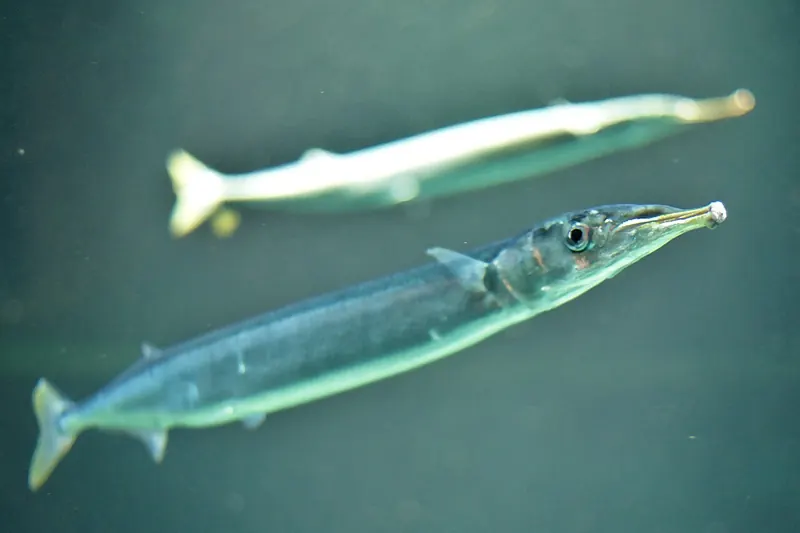
Photo: Thomas Vogt from Paderborn, Deutschland, Wikimedia Commons, CC BY-SA 2.0, adjusted to 3:2
- Spawning
- Mainly May to June in shallow water, the eggs stick to stones and plants with sticky threads (general guide, varies by region)
- German Red List
- not threatened
- Typical method
- Float fishing with fish strips just below the surface
- Top bait
- Herring strips
How to recognise it
- Very slender, long body, blue-green back and silvery grey belly
- Both jaws extended into a tweezer-like, toothed beak, the lower jaw slightly longer
- Only one dorsal fin, set far back opposite the anal fin just before the tail
Easily confused with: Looks like the Atlantic saury, which stays smaller and has 5 to 7 small finlets between the dorsal and anal fins and the tail fin; the garfish has no finlets.
How to catch it
Methods: Float fishing with fish strips just below the surface, Lure fishing (spinning) with slim spoons, Sbirolino fishing
Baits: Herring strips, Mackerel strips, Slim coastal spoon, Small hard lure
In spring, when the shoals move into shallow water to spawn, and in warm summer weeks; in daytime close to the surface.
Habitat and food
Northeast Atlantic from Iceland and northern Norway through the North Sea and western Baltic Sea to the Bay of Biscay, with separate subspecies in the Mediterranean and Black Sea. A shoaling fish living just below the surface that makes long feeding migrations similar to the mackerel (Wikipedia). Moves into shallow water in April and May and spawns over seagrass beds, returning to the open sea in autumn (English Wikipedia).
A daytime predator hunting small fish such as sand eels, young herring, sardines and anchovies (Wikipedia), plus free-swimming crustaceans (English Wikipedia).
Size and age
Up to about 90 cm and 1.3 kg, usually 45 to 70 cm and rarely over 1 kg (Wikipedia). FishBase: max. 104 cm, common length 45 cm (standard length), max. published weight 1.4 kg.
Protection and rules
We found no minimum size or closed season for this species in any state fisheries regulation. Local water rules may still apply.
Closed seasons and minimum sizes are set by each German state and can be stricter for single waters. All rules by state, with the legal source
In the kitchen
White flesh, sold fresh, as fillets, grilled or baked (Wikipedia). The bones turn green when cooked, caused by the harmless pigment biliverdin.
Sources (5)
- de.wikipedia.org/wiki/Gewöhnlicher_Hornhecht
- fishbase.se/summary/Belone-belone.html
- rote-liste-zentrum.de/detail/pdf/224870
- de.wikipedia.org/wiki/Makrelenhecht
- en.wikipedia.org/wiki/Garfish
Last checked 2026-10-13. Found a mistake? Write to [email protected].
Know more?
Additions, photos of your catches or a mistake in the text: write to us and we will gladly credit you as a helper.
Send a tip