Species
Largemouth bass
One of the most popular game fish in the United States: a heavy-bodied sunfish with a huge mouth that ambushes prey from weeds, wood and docks and often jumps when hooked.
Micropterus salmoides
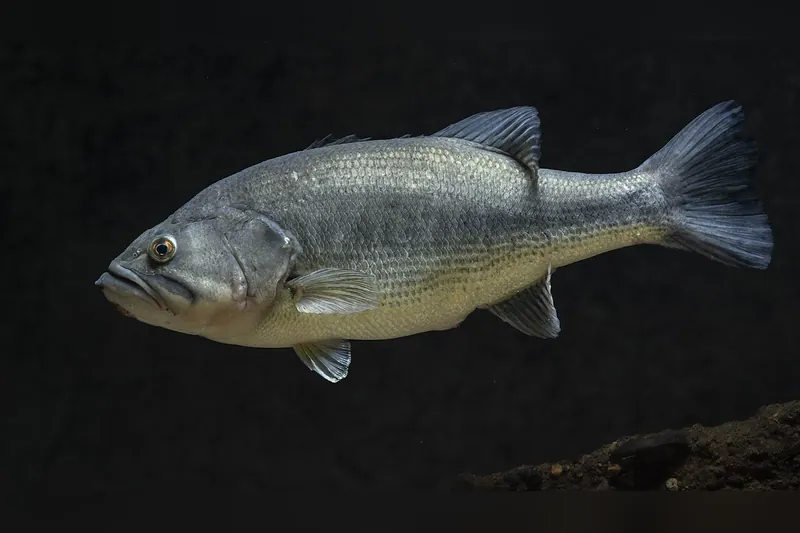
Photo: USFWS Mountain Prairie, Wikimedia Commons, Public domain, adjusted to 3:2
- Spawning
- Spring, once the water stays above about 60 °F (16 °C): in the South from March to June, in the North from late April to early July. The male fans out a nest on sand or gravel and guards eggs and fry (Wikipedia, TPWD; general guide, varies by region)
- Typical method
- Texas-rigged soft plastic worm
- Top bait
- Soft plastic worm
How to recognise it
- Big mouth: the upper jaw extends past the rear edge of the eye
- Olive green to greenish gray with a dark, jagged horizontal stripe along the side
- Dorsal fin almost split in two by a deep notch, the spiny front part lower than the soft rear part
Easily confused with: The smallmouth bass has a smaller mouth that ends below the eye, dark vertical bars instead of a horizontal stripe and only a shallow notch in the dorsal fin. A 2022 study treats the Florida bass as a separate species named Micropterus salmoides and the northern largemouth as Micropterus nigricans (English Wikipedia); TPWD and FishBase still list it as M. salmoides.
How to catch it
Methods: Texas-rigged soft plastic worm, Spinnerbaits and crankbaits, Topwater lures around weeds and wood, Live bait such as shiners
Baits: Soft plastic worm, Jig, Spinnerbait, Crankbait, Live golden shiner, Crawfish
In spring around the spawn, when fish move shallow; otherwise around cover such as weed beds, timber and docks. In the heat of summer and in winter big bass get sluggish, and large live shiners tend to work better (Wikipedia).
Habitat and food
Native to the eastern and central United States, southeastern Canada and northern Mexico (Great Lakes, St. Lawrence and Mississippi basins south to Texas and Florida); stocked as a game fish around the world. Prefers quiet, fairly clear water with plenty of shoreline vegetation and cover such as weeds, logs, rock ledges and docks; also enters brackish water (Wikipedia, TPWD).
Adults mainly eat fish such as bluegill and other sunfish, shad and minnows, plus crawfish, frogs, snakes and salamanders; prey can be half the length of the bass. Juveniles eat zooplankton, insect larvae and small crustaceans (Wikipedia, TPWD).
Size and age
Commonly around 40 cm (16 in) (FishBase). Wikipedia gives a maximum recorded length of 75 cm (29.5 in) and an unofficial maximum weight of 11.4 kg (25 lb 1 oz). The IGFA world record is shared: 10.12 kg (22 lb 5 oz) from Lake Biwa, Japan (2009) and 10.09 kg (22 lb 4 oz) from Montgomery Lake, Georgia (1932) (Wikipedia). FishBase: max. 97 cm, maximum published weight 10.1 kg, maximum age 23 years. The sources differ on maximum length.
Protection and rules
We found no minimum size or closed season for this species in any state fisheries regulation. Local water rules may still apply.
Closed seasons and minimum sizes are set by each German state and can be stricter for single waters. All rules by state, with the legal source
In the kitchen
Edible; FishBase lists a minor commercial fishery and aquaculture. In U.S. bass fishing the sport usually comes first, and many anglers release their fish.
Sources (4)
- de.wikipedia.org/wiki/Forellenbarsch
- en.wikipedia.org/wiki/Largemouth_bass
- fishbase.se/summary/Micropterus-salmoides.html
- tpwd.texas.gov/huntwild/wild/species/lmb/
Last checked 2026-10-15. Found a mistake? Write to [email protected].
Know more?
Additions, photos of your catches or a mistake in the text: write to us and we will gladly credit you as a helper.
Send a tip