Species
European plaice
Europe's most important flatfish, also called Goldbutt in German, recognisable by its orange-red spots and a sought-after food fish.
Pleuronectes platessa
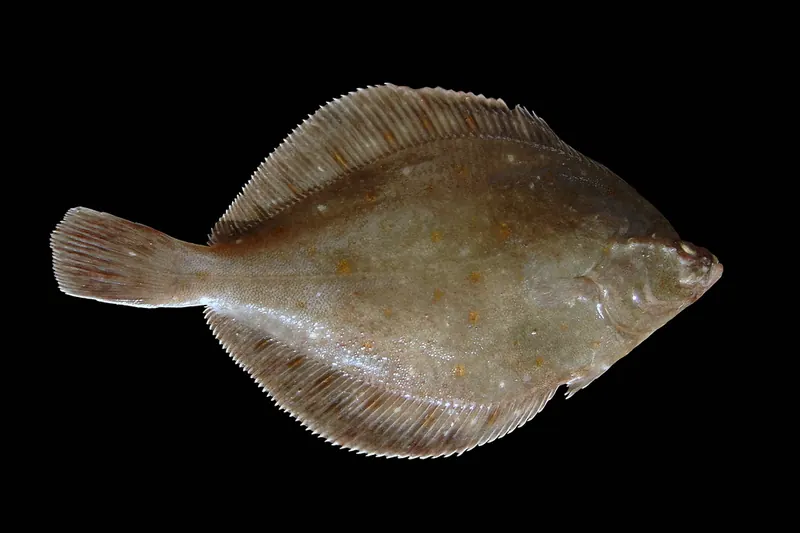
Photo: Hans Hillewaert, Wikimedia Commons, CC BY-SA 4.0, adjusted to 3:2
- Spawning
- December to May, main season in the winter months (general guide, varies by region)
- German Red List
- not threatened
- Typical method
- Surf casting
- Top bait
- Lugworm
How to recognise it
- Smooth, grey-brown upper side with orange-red to yellowish spots
- Eyes on the right side of the body, white underside
- Bony knobs behind the eyes
Easily confused with: Often mistaken for the flounder: the plaice is smooth and has bright spots, the flounder is rough along the lateral line and the edge of the fins.
How to catch it
Methods: Surf casting, Bottom fishing from a boat, Drift fishing with a flatfish spoon (Buttlöffel)
Baits: Lugworm, Ragworm, Mussel meat, Flatfish spoon with worm
From spring into autumn, especially at dusk and at night; plaice caught in spring are sold as Maischolle (May plaice).
Habitat and food
Sandy and muddy bottoms on almost all European coasts, in the North Sea and western Baltic Sea; older plaice live deeper, young ones often in shallow water off bathing beaches and in the Wadden Sea.
Mainly thin-shelled mussels and bristle worms, plus small crustaceans, snails and lugworms; usually feeds at night.
Size and age
Adults 40 to a maximum of 70 cm, up to 7 kg and up to 45 years; plaice of almost 1 m and up to 50 years old used to be caught, today catch sizes are 25 to 40 cm (Wikipedia). FishBase: max. 100 cm, heaviest published weight 7.0 kg, maximum age 50 years.
Protection and rules
Closed seasons and minimum sizes are set by each German state (and by each country abroad) and can be stricter on individual waters. We are building an overview with sources and check dates. Until then, check the local fishing regulations and the rules of the club or permit for your water.
In the kitchen
Tender, mild, white flesh; classically pan-fried whole, in the north often with bacon.
Sources (4)
- de.wikipedia.org/wiki/Scholle_(Fisch)
- fishbase.se/summary/Pleuronectes-platessa.html
- rote-liste-zentrum.de/detail/pdf/225041
- en.wikipedia.org/wiki/European_plaice
Last checked 2026-10-10. Found a mistake? Write to [email protected].
Know more?
Additions, photos of your catches or a mistake in the text: write to us and we will gladly credit you as a helper.
Send a tip