Species
Red drum
A powerful drum of the Atlantic and Gulf coasts, also called redfish or channel bass: copper red with a black eyespot at the tail base, hunting shallow grass flats and the surf.
Sciaenops ocellatus
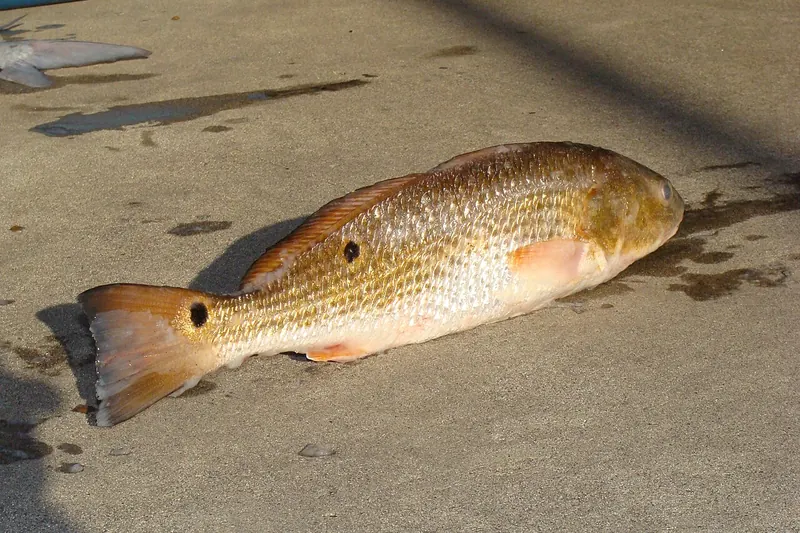
Photo: Geeklikepi, Wikimedia Commons, CC BY-SA 3.0, adjusted to 3:2
- Spawning
- Mid-August to mid-October near passes and inlets and along barrier island beaches; males drum by vibrating the swim bladder (Wikipedia, TPWD; general guide, varies by region)
- Typical method
- Popping cork with live shrimp
- Top bait
- Live shrimp
How to recognise it
- One large black spot on the upper tail base, sometimes several, almost never none
- Back copper red to bronze, nearly silver in some fish, white belly
- Downturned mouth with no barbels, large scales, two dorsal fins
Easily confused with: The black drum is higher backed and has many barbels under the lower jaw, and young fish show dark vertical bars (TPWD). The two species often live side by side and occasionally hybridize (Wikipedia).
How to catch it
Methods: Popping cork with live shrimp, Bottom rig with live baitfish or crab on a slip sinker, Wade fishing and sight casting spoons on the flats, Surf fishing, Sight fishing with a fly rod
Baits: Live shrimp, Finger mullet, Croaker, Small blue crab, Gold weedless spoon, Soft plastic under a cork
Year round; in fall big spawners move to the Gulf beaches (the "bull redfish run"), in winter they gather in tidal creeks and rivers. On shallow grass flats look for tails sticking out of the water (TPWD).
Habitat and food
Atlantic coast from Massachusetts to Florida and the Gulf of Mexico to northern Mexico, less often south to northern Brazil (German Wikipedia). Juveniles live in bays, estuaries and salt marshes, older fish around jetties, bridge pilings, oyster reefs and in the surf. Often swims so shallow its back is out of the water; in winter also moves into tidal creeks and far up rivers (Wikipedia, TPWD).
Juveniles eat small crabs, shrimp and worms, older fish crabs, shrimp and fish such as mullet, menhaden and croaker. Feeds mostly on the bottom and roots in shallow grass with its tail sticking out of the water ("tailing") (Wikipedia, TPWD).
Size and age
Three-year-old fish usually weigh 6 to 8 lb (2.7 to 3.6 kg). The largest on record weighed just over 94 lb (43 kg) and was caught off Hatteras Island in 1984; Wikipedia says red drum can live to 60 years. FishBase: max. 155 cm, maximum published weight 45.0 kg, maximum age 50 years; TPWD gives 37 years as the oldest recorded fish. The sources differ on maximum age.
Protection and rules
We found no minimum size or closed season for this species in any state fisheries regulation. Local water rules may still apply.
Closed seasons and minimum sizes are set by each German state and can be stricter for single waters. All rules by state, with the legal source
In the kitchen
Moderate flavor and not oily; fish over about 15 lb (6.8 kg) get tough. The large scales are hard to remove, so many anglers fillet with the skin on and then cut the meat away from skin and scales (Wikipedia).
Sources (5)
Know more?
Additions, photos of your catches or a mistake in the text: write to us and we will gladly credit you as a helper.
Send a tip