Species
Sea trout
The silver, migratory form of the trout, which feeds at sea and runs up rivers to spawn; a sought-after fish on the Baltic coast and in its long inlets (Förden).
Salmo trutta trutta
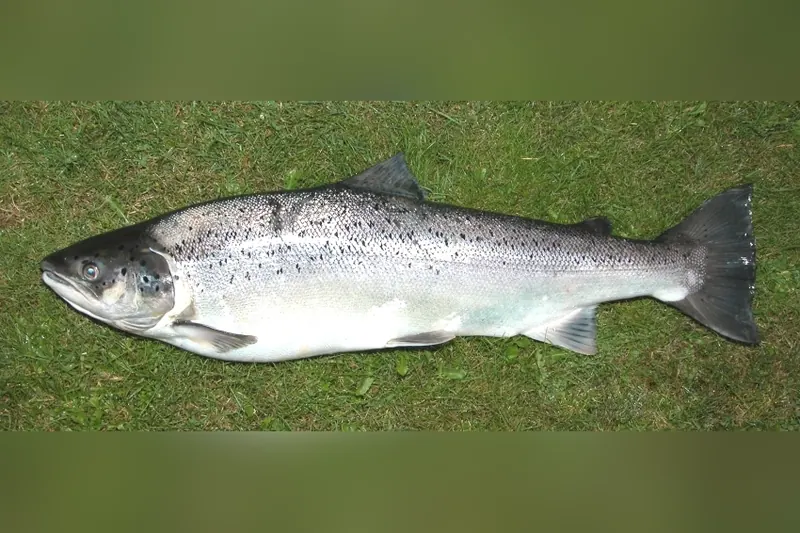
Photo: Wolfgang Striewski, Wikimedia Commons, Public domain, adjusted to 3:2
- Spawning
- In winter (general guide, varies by region)
- German Red List
- threatened
- Typical method
- Lure fishing (spinning) on the coast
- Top bait
- Coastal spoon
How to recognise it
- Torpedo-shaped body with grey-silver flanks and a white belly
- Black spots, often X-shaped, mainly above the lateral line
- Small adipose fin, strong tail root
Easily confused with: Easily mistaken for the salmon: the sea trout has a stronger tail root and its mouth reaches back behind the eye. Fish that stay in the river for longer turn brown and then look like the brown trout.
How to catch it
Methods: Lure fishing (spinning) on the coast, Fly fishing on the coast, Sbirolino or float fishing with worm
Baits: Coastal spoon, Slim plug (crankbait), Shrimp or bristle worm fly, Ragworm
Mainly in spring and autumn when the water is cool, ideally at dusk and when the sea is slightly choppy.
Habitat and food
Coastal waters of Europe from the Norwegian Sea across the North Sea and Baltic Sea to the Bay of Biscay. At sea it usually roams close to the coast, and to spawn it runs up into small rivers with a gravel bed.
At sea mainly small fish, crustaceans and shrimp; young fish in the river eat insects.
Size and age
On average around 60 cm; in good conditions up to 130 cm and 20 kg (Wikipedia). For the whole species Salmo trutta, FishBase gives a maximum of 140 cm, a heaviest published weight of 50 kg and a maximum age of 38 years; these figures include all forms of the trout.
Protection and rules
Closed seasons and minimum sizes are set by each German state (and by each country abroad) and can be stricter on individual waters. We are building an overview with sources and check dates. Until then, check the local fishing regulations and the rules of the club or permit for your water.
In the kitchen
Firm, flavourful flesh, good pan-fried, cured or smoked; spawned-out fish (kelts, Absteiger in German) are lean and dry and are usually released.
Sources (3)
- de.wikipedia.org/wiki/Meerforelle
- fishbase.se/summary/Salmo-trutta.html
- rote-liste-zentrum.de/detail/pdf/91294
Last checked 2026-10-10. Found a mistake? Write to [email protected].
Know more?
Additions, photos of your catches or a mistake in the text: write to us and we will gladly credit you as a helper.
Send a tip