Species
Common ling
One of the largest members of the cod order: a long, marbled predator with a chin barbel, caught mainly by boat anglers in Norway over rocky ground.
Molva molva
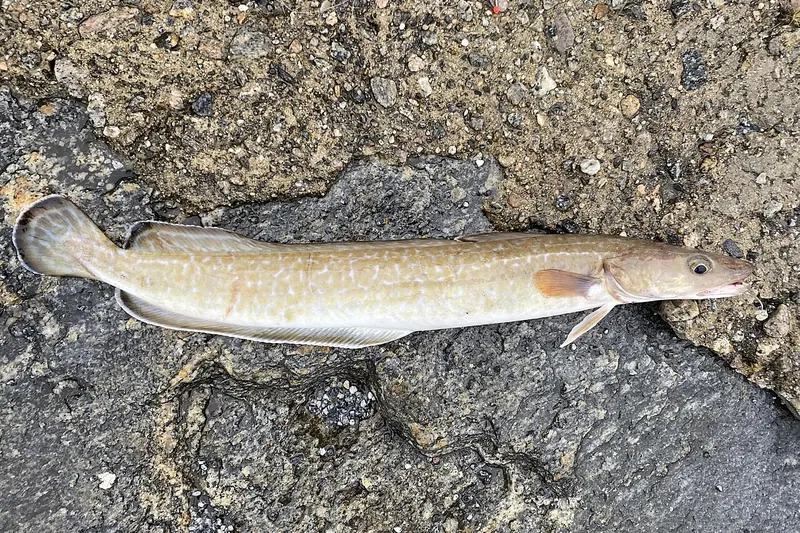
Photo: Vsevolod, Wikimedia Commons, CC BY 4.0, adjusted to 3:2
- Spawning
- April to June at about 100 to 200 m depth at water temperatures of about 7 °C (general guide, varies by region)
- German Red List
- extremely rare
- Typical method
- Bottom fishing with natural bait from a boat
- Top bait
- Large fish strip
How to recognise it
- Long, slender body, back and flanks marbled brown, belly yellow to white
- One barbel on the lower jaw, longer than the eye diameter
- Two dorsal fins, the rear one very long; dorsal and anal fins with a pale edge
Easily confused with: Looks like the blue ling, which has a thinner tail stalk (Wikipedia). The related burbot looks similar but lives in fresh water.
How to catch it
Methods: Bottom fishing with natural bait from a boat, Jigging with pirks over rocky ground and drop-offs, Soft plastic fish on a heavy jig head
Baits: Large fish strip, Mackerel fillet, Whole herring, Pirk, Large soft plastic fish
Mainly when boat fishing in Norway over rocky ground in deep water, where ling are most common (FishBase: mostly 100 to 400 m).
Habitat and food
Coastal zones of the eastern Atlantic from Scandinavia and Iceland to the Bay of Biscay, plus the North Sea and Skagerrak, occasionally the western Mediterranean; on the bottom at depths of up to 400 m (Wikipedia). Mainly over rocky ground, most commonly at 100 to 400 m (FishBase). Extremely rare in German waters (Red List).
A predator eating fish such as herring, cod and flatfish, plus crustaceans, cephalopods and starfish (Wikipedia).
Size and age
Up to 1.8 m, rarely also 2 m, and up to 40 kg; males mature at about 80 cm, females at about 90 to 100 cm (Wikipedia). FishBase: max. 200 cm, common length 106 cm, max. published weight 45.0 kg, max. reported age 25 years.
Protection and rules
We found no minimum size or closed season for this species in any state fisheries regulation. Local water rules may still apply.
Closed seasons and minimum sizes are set by each German state and can be stricter for single waters. All rules by state, with the legal source
In the kitchen
Firm, white flesh; sold fresh, dried, salted or frozen, steamed, fried or baked (FishBase); also preserved in lye (English Wikipedia).
Sources (4)
- de.wikipedia.org/wiki/Leng
- fishbase.se/summary/Molva-molva.html
- rote-liste-zentrum.de/detail/pdf/225008
- en.wikipedia.org/wiki/Common_ling
Last checked 2026-10-13. Found a mistake? Write to [email protected].
Know more?
Additions, photos of your catches or a mistake in the text: write to us and we will gladly credit you as a helper.
Send a tip