Species
Common dab
A small, common North Sea flatfish with a semicircular curve in its lateral line that is easy to catch from the shore.
Limanda limanda
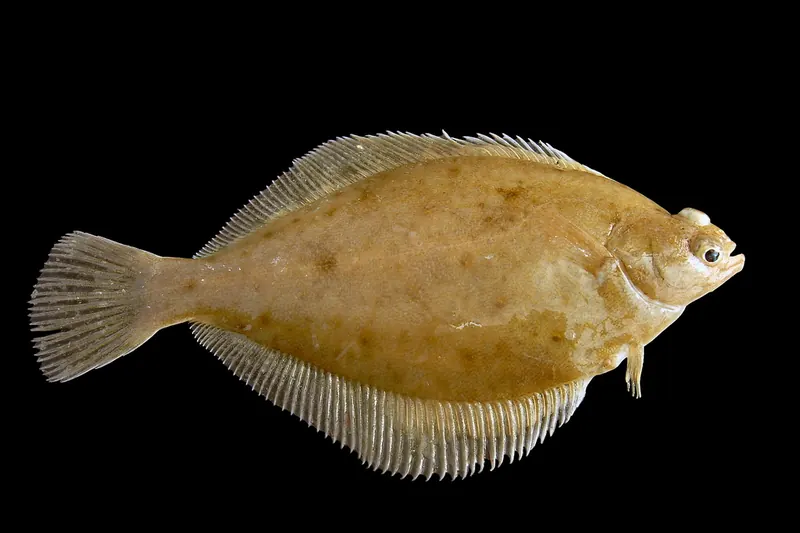
Photo: Hans Hillewaert, Wikimedia Commons, CC BY-SA 4.0, adjusted to 3:2
- Spawning
- December to June, peaking from March to May, according to other sources February to April (general guide, varies by region)
- German Red List
- not threatened
- Typical method
- Surf fishing
- Top bait
- Lugworm
How to recognise it
- Lateral line with a distinct semicircular curve above the pectoral fin
- Eyes on the right side, upper side pale brown with darker blotches, no orange spots
- Scales with rough rear edges, no large bony knobs
Easily confused with: Often confused with the plaice, which has orange-red spots and bony knobs behind the eyes. The flounder has no curve in its lateral line and is rough along the lateral line and the fin bases.
How to catch it
Methods: Surf fishing, Bottom fishing from piers and groynes, Drift fishing from a boat
Baits: Lugworm, Ragworm, Shrimp, Mussel meat
The dab is a resident fish that only moves between deeper water and the coast (Wikipedia); from the shore mainly at dusk and at night.
Habitat and food
Western and northern European coasts from the Bay of Biscay to about the latitude of Trondheim and in the Baltic Sea to about the latitude of Gotland, mainly in the southern North Sea. Sandy, soft bottoms down to around 100 m, including the Wadden Sea (Wikipedia).
Invertebrates such as brittle stars, worms, mussels and crustaceans, occasionally small fish (Wikipedia).
Size and age
Up to 40 cm, highest known age twelve years (Wikipedia). FishBase: max. 40 cm (standard length), max. published weight 1.0 kg, max. reported age 12 years.
Protection and rules
Common dab: closed season and minimum size by German state
- Mecklenburg-Western Pomeraniaminimum size 25 cm (coast)
- Schleswig-Holsteinminimum size 23 cm (coast)
From the official state fisheries regulations, retrieved 2026-10-11. All rules by state
Closed seasons and minimum sizes are set by each German state and can be stricter for single waters. All rules by state, with the legal source
In the kitchen
Tender, mild flesh; sold fresh, dried or smoked and cheaper than sole (Wikipedia). Classically pan-fried whole.
Sources (4)
- de.wikipedia.org/wiki/Kliesche
- fishbase.se/summary/Limanda-limanda.html
- rote-liste-zentrum.de/detail/pdf/224972
- en.wikipedia.org/wiki/Common_dab
Last checked 2026-10-13. Found a mistake? Write to [email protected].
Know more?
Additions, photos of your catches or a mistake in the text: write to us and we will gladly credit you as a helper.
Send a tip