Species
Channel catfish
North America's most abundant catfish: a sleek catfish with eight barbels and a deeply forked tail that finds its food by smell and taste.
Ictalurus punctatus
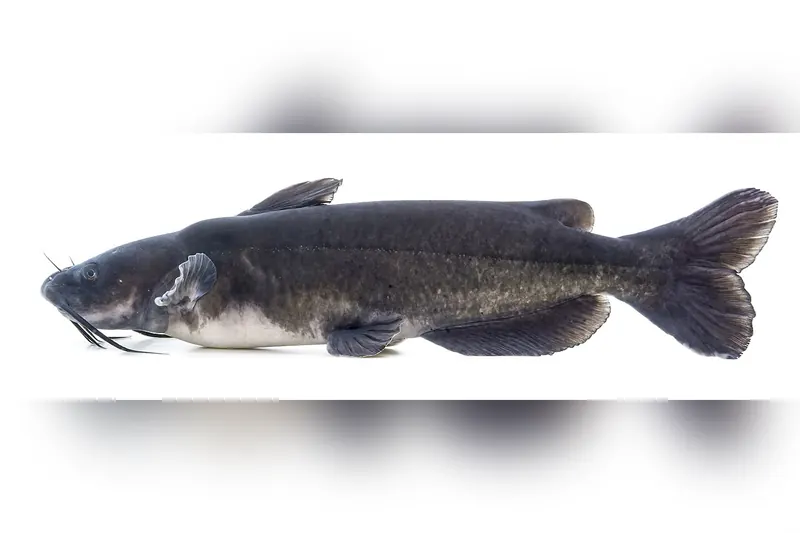
Photo: USFWS Mountain Prairie, Wikimedia Commons, Public domain, adjusted to 3:2
- Spawning
- Late spring to early summer when the water reaches about 75 °F (24 °C); spawns in dark cavities such as undercut banks, hollow logs or drift piles, and the male guards eggs and fry (TPWD; general guide, varies by region)
- Typical method
- Bottom fishing with natural bait
- Top bait
- Chicken liver
How to recognise it
- No scales, back olive brown to slate blue, belly silvery white
- Eight barbels, deeply forked tail and an adipose fin
- Usually many small black spots on the sides, often faded in big adults; upper jaw sticks out past the lower jaw
Easily confused with: The blue catfish looks very similar but has 30 to 35 rays in the anal fin, the channel catfish only 24 to 29, and it usually lacks spots. The flathead catfish has a protruding lower jaw. The deeply forked tail sets it apart from every other catfish except the blue, including bullheads (TPWD).
How to catch it
Methods: Bottom fishing with natural bait, Slip bobber fishing near the bottom, Soaking cut bait or stink bait
Baits: Chicken liver, Nightcrawler, Cut shad, Shrimp, Stink bait, Grasshopper
Late spring through fall; because it finds food by smell and taste, it bites well in muddy water and after dark (Wikipedia).
Habitat and food
Native to southern Canada, most of the United States between the Appalachians and the Rockies (mainly the Mississippi basin), peninsular Florida and northern Mexico; widely introduced elsewhere. Lives in rivers, reservoirs, lakes and ponds, and is most abundant in large rivers with low to moderate current (Wikipedia, TPWD).
Omnivore: insects, snails, clams, crawfish, frogs and small fish, plus aquatic plants, algae and seeds; fish over 18 in (45 cm) eat more fish such as yellow perch and sunfish (Wikipedia, TPWD).
Size and age
Adults usually at least 12 in (30 cm) and 2 to 4 lb (0.9 to 1.8 kg); the record fish weighed 58 lb (26 kg) and was caught in South Carolina in 1964 (Wikipedia; TPWD lists 58 lb as the North American record). FishBase: max. 132 cm, maximum published weight 26.3 kg, maximum age 24 years.
Protection and rules
We found no minimum size or closed season for this species in any state fisheries regulation. Local water rules may still apply.
Closed seasons and minimum sizes are set by each German state and can be stricter for single waters. All rules by state, with the legal source
In the kitchen
An important food fish in the southern U.S., valued for the quality of its meat; channel catfish make up about 90 percent of farm-raised catfish in the U.S. (Wikipedia). TPWD praises its flavor.
Sources (5)
Know more?
Additions, photos of your catches or a mistake in the text: write to us and we will gladly credit you as a helper.
Send a tip