Species
Walleye
The North American cousin of the European zander: a golden olive predator with big, glassy eyes that feeds mostly at dawn, dusk and night.
Sander vitreus
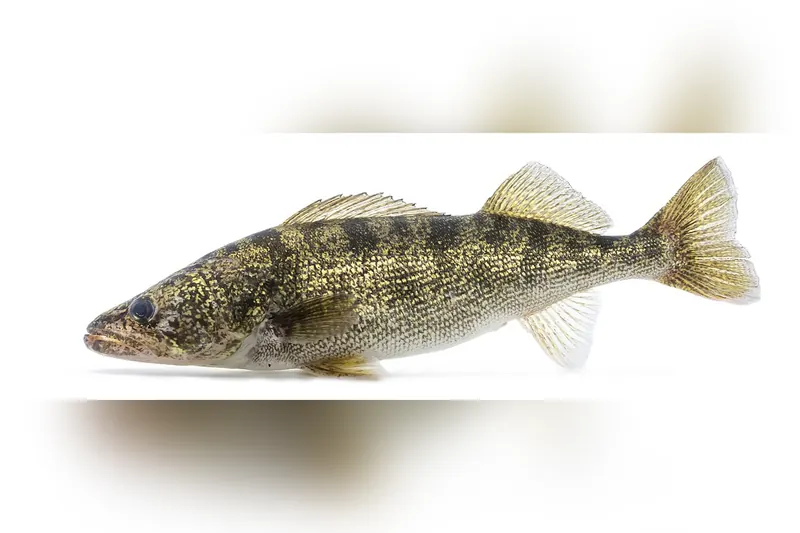
Photo: USFWS Mountain Prairie, Wikimedia Commons, Public domain, adjusted to 3:2
- Spawning
- Late winter to spring at 43 to 50 °F (6 to 10 °C) (German Wikipedia: February to April); fish run up tributaries or onto gravel and rock reefs, spawn mostly at night and give no parental care (Wikipedia, TPWD; general guide, varies by region)
- Typical method
- Jigging with a live minnow or soft plastic
- Top bait
- Live minnow
How to recognise it
- Large, milky looking eye (a reflective layer behind the retina)
- Two separate dorsal fins, the spiny front one with a dark blotch at its rear base
- Olive back, golden sides with dark saddles, white tip on the lower lobe of the tail; sharp teeth
Easily confused with: The sauger (Sander canadensis) lacks the white tip on the tail and has rows of black dots on both dorsal fins and the tail (Wikipedia). The European zander is a close relative; a U.S. court ruling bars selling zander fillets as walleye (German Wikipedia).
How to catch it
Methods: Jigging with a live minnow or soft plastic, Trolling crankbaits, Night fishing with live bait, Ice fishing in winter
Baits: Live minnow, Leech, Nightcrawler, Jig with soft plastic, Crankbait
Dawn, dusk, night and overcast days; a wind-driven "walleye chop" boosts feeding. Shallower in spring and fall, deeper in summer; a classic ice fishing target in winter (Wikipedia).
Habitat and food
Native to most of Canada and the northern United States, from Quebec to the Northwest Territories and south to Alabama and Arkansas; stocking has spread it further. Lives in large lakes, reservoirs and rivers; shallower and over rocky bottoms in spring and fall, deeper in summer (Wikipedia, FishBase).
Adults eat almost only fish, often yellow perch or ciscoes, plus crawfish, minnows and leeches. Young walleye first eat insect larvae and zooplankton and switch to fish after 40 to 60 days (Wikipedia).
Size and age
Usually caught at 12 to 20 in (30 to 50 cm); they can reach about 80 cm (31 in) and 9 kg (20 lb), with a maximum recorded size of 107 cm (42 in) and 13 kg (29 lb). All-tackle world record 25 lb (11.34 kg) from Old Hickory Lake, Tennessee, 1960 (Wikipedia). FishBase: max. 107 cm (fork length), maximum published weight 11.3 kg, maximum age 29 years.
Protection and rules
We found no minimum size or closed season for this species in any state fisheries regulation. Local water rules may still apply.
Closed seasons and minimum sizes are set by each German state and can be stricter for single waters. All rules by state, with the legal source
In the kitchen
Considered an excellent food fish (TPWD); fried walleye is a staple in Canada and Minnesota, where the walleye sandwich is a pub classic (Wikipedia).
Sources (4)
- de.wikipedia.org/wiki/Glasaugenbarsch
- en.wikipedia.org/wiki/Walleye
- fishbase.se/summary/Sander-vitreus.html
- tpwd.texas.gov/huntwild/wild/species/walleye/
Last checked 2026-10-15. Found a mistake? Write to [email protected].
Know more?
Additions, photos of your catches or a mistake in the text: write to us and we will gladly credit you as a helper.
Send a tip