Species
Prussian carp
A silvery carp-like fish without barbels, also called silver crucian carp, which is spreading strongly and displacing the native crucian carp.
Carassius gibelio
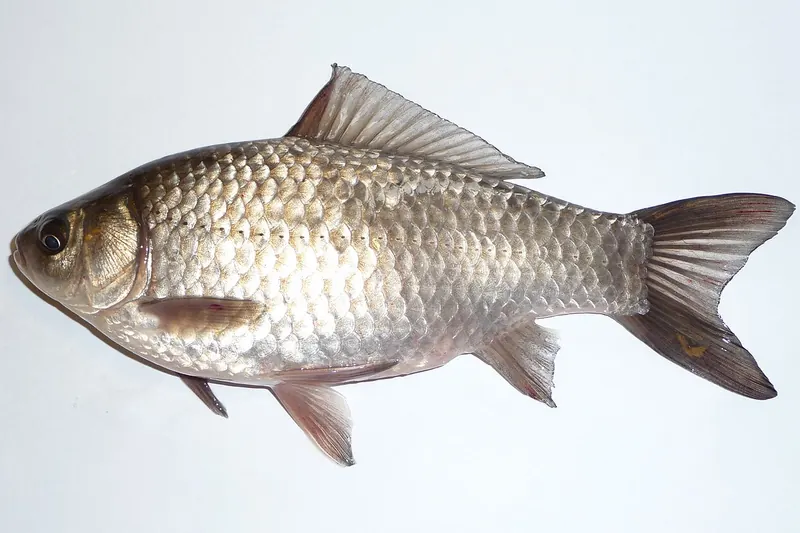
Photo: George Chernilevsky, Wikimedia Commons, CC BY-SA 3.0, adjusted to 3:2
- Spawning
- Not exactly documented; spawns on water plants in shallow, warm shore areas (FishBase). Many populations consist only of females, which spawn together with other carp-like species.
- German Red List
- not assessed
- Typical method
- Float fishing
- Top bait
- Maggots
How to recognise it
- Deep body without barbels and with a silvery grey-green sheen
- Dorsal fin straight or slightly curved inwards (concave)
- Lining of the body cavity almost black (visible when gutting)
Easily confused with: Very similar to the crucian carp: the Prussian carp has a straight or concave dorsal fin, 27 to 33 scales along the lateral line and a dark body cavity lining, the crucian carp a convex dorsal fin and a pale lining. The lack of barbels sets it apart from the common carp.
How to catch it
Methods: Float fishing, Feeder fishing
Baits: Maggots, Sweetcorn, Worm, Paste
Not specifically documented; Prussian carp live in nutrient-rich waters that warm up in summer (Wikipedia).
Habitat and food
Still and slow-flowing waters that warm up in summer and are rich in nutrients, usually with water plants. It makes few demands on water quality and tolerates low oxygen and slightly salty water.
Omnivore: plankton, bottom-living animals, plant material and detritus.
Size and age
Usually around 40 cm; larger individual cases have been described but not verified. Adult females weigh 2.0 to 2.5 kg on average (Wikipedia). FishBase: max. 46.6 cm, heaviest published weight 4.8 kg, maximum age 10 years.
Protection and rules
Prussian carp: closed season and minimum size by German state
- Berlinno minimum size, no closed season
From the official state fisheries regulations, retrieved 2026-10-11. All rules by state
Closed seasons and minimum sizes are set by each German state and can be stricter for single waters. All rules by state, with the legal source
In the kitchen
Few bones but bland, pale flesh; in Germany and Austria not a sought-after angling fish, whereas in Eastern Europe and East Asia it is an important commercial fish.
Sources (3)
- de.wikipedia.org/wiki/Giebel_(Fisch)
- fishbase.se/summary/Carassius-gibelio.html
- rote-liste-zentrum.de/detail/pdf/91170
Last checked 2026-10-13. Found a mistake? Write to [email protected].
Know more?
Additions, photos of your catches or a mistake in the text: write to us and we will gladly credit you as a helper.
Send a tip