Species
Spotted seatrout
A favorite inshore fish of the Gulf and the U.S. East Coast, also called speckled trout: not a trout but a drum, with round black spots and sharp canine teeth.
Cynoscion nebulosus
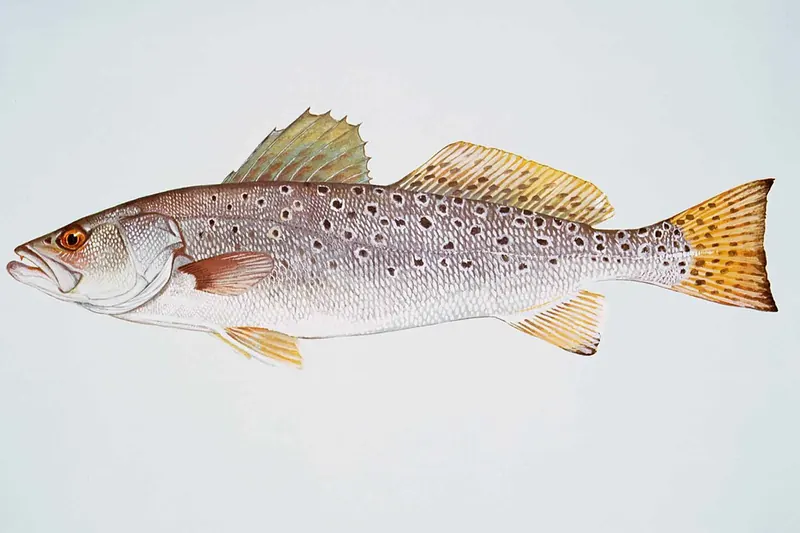
Photo: Raver Duane, U.S. Fish and Wildlife Service, Wikimedia Commons, Public domain, adjusted to 3:2
- Spawning
- Long season from spring through summer, March to October according to German Wikipedia; spawns between dusk and dawn over shallow grassy areas of bays and lagoons, and males drum (Wikipedia, TPWD; general guide, varies by region)
- Typical method
- Popping cork with live shrimp
- Top bait
- Live shrimp
How to recognise it
- Silvery, elongated body, back dark gray to greenish
- Many round black spots on the back that extend onto the dorsal fin and tail
- One or two large canine teeth at the tip of the upper jaw; dorsal fin split by a deep notch
Easily confused with: Despite the name it is not a trout but a member of the drum family. The closely related weakfish (Cynoscion regalis) and the sand seatrout look similar; distinct round spots that also cover the dorsal fin and tail point to spotted seatrout (Wikipedia, TPWD).
How to catch it
Methods: Popping cork with live shrimp, Free-shrimping on a drift, Casting jigs, spoons and plugs, Night fishing under lights with small jigs
Baits: Live shrimp, Mullet or pinfish, Worm jig, Silver spoon, Topwater plug
Spring and summer on shallow grass flats; spoons work best in the warm months, slowly worked fish-shaped lures in the cold season. At night fish gather under lights (TPWD).
Habitat and food
Western Atlantic from New York to southern Florida and throughout the Gulf of Mexico, most common from Florida to Texas (FishBase, German Wikipedia). Lives in estuaries and shallow bays over sand, around seagrass beds and oyster reefs, and handles widely varying salinity. In fall it moves into deeper bays, channels and rivers, returning to the shallows in spring (TPWD).
Small trout eat shrimp and other crustaceans, medium ones shrimp and small fish, large ones almost only fish such as mullet, pinfish and menhaden; big trout take mullet up to two thirds of their own length (Wikipedia, TPWD).
Size and age
Usually 1.1 to 2.2 lb (0.5 to 1 kg), fish up to 5.5 lb (2.5 kg) fairly common, 7.7 to 9.9 lb (3.5 to 4.5 kg) rare; world record 17 lb 7 oz (7.9 kg) (Wikipedia). FishBase: max. 100 cm, common length 36 cm, maximum published weight 7.9 kg, maximum age 18 years.
Protection and rules
We found no minimum size or closed season for this species in any state fisheries regulation. Local water rules may still apply.
Closed seasons and minimum sizes are set by each German state and can be stricter for single waters. All rules by state, with the legal source
In the kitchen
A popular food fish; Monterey Bay Aquarium Seafood Watch rates it a "best choice" in Louisiana and Florida (Wikipedia). Some fish carry tapeworm larvae in the flesh along the backbone; according to TPWD they cannot survive in humans and are easy to remove when cleaning.
Sources (4)
- de.wikipedia.org/wiki/Cynoscion_nebulosus
- en.wikipedia.org/wiki/Spotted_seatrout
- fishbase.se/summary/Cynoscion-nebulosus.html
- tpwd.texas.gov/huntwild/wild/species/strout/
Last checked 2026-10-15. Found a mistake? Write to [email protected].
Know more?
Additions, photos of your catches or a mistake in the text: write to us and we will gladly credit you as a helper.
Send a tip