Species
European flounder
A flatfish of coasts and estuaries that loves brackish water, travels far up rivers and is a classic for surf casting.
Platichthys flesus
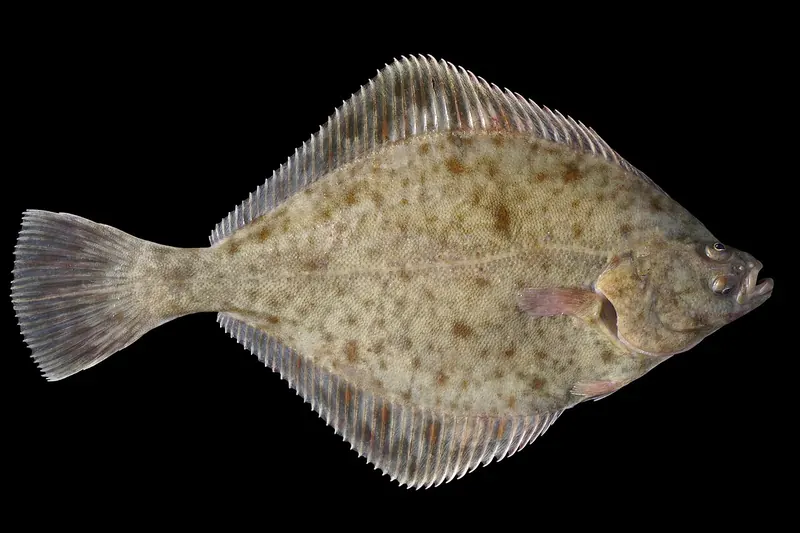
Photo: Hans Hillewaert, Wikimedia Commons, CC BY-SA 4.0, adjusted to 3:2
- Spawning
- In the southern North Sea February to May, in the far north April to June, at sea (general guide, varies by region)
- German Red List
- not threatened
- Typical method
- Surf casting
- Top bait
- Lugworm
How to recognise it
- Oval, strongly flattened body, eyes usually on the right side
- Rough bony knobs along the lateral line and the base of the fins
- Small mouth, often pale reddish spots on the upper side
Easily confused with: Looks like the European plaice: the flounder feels rough along the lateral line and the edge of the fins, the plaice is smooth and has bright orange spots.
How to catch it
Methods: Surf casting, Bottom fishing from a pier or boat, Drift fishing with a flatfish spoon (Buttlöffel)
Baits: Lugworm, Ragworm, Mussel meat, Flatfish spoon with worm
In the evening and at night, when it goes looking for food; during the day it often lies buried in the sand.
Habitat and food
Sandy and muddy coasts from the North Sea and Baltic Sea to the Mediterranean, preferring brackish water in estuaries, inlets (Förden) and bays; individual fish migrate far up the rivers.
Isopods, amphipods, molluscs and bristle worms; in fresh water mainly midge and caddisfly larvae.
Size and age
Usually 25 to 30 cm and around 300 g, maximum 50 cm (Wikipedia). FishBase, on the other hand, gives a maximum of 60 cm, a heaviest published weight of 2.9 kg and a maximum age of 15 years.
Protection and rules
Closed seasons and minimum sizes are set by each German state (and by each country abroad) and can be stricter on individual waters. We are building an overview with sources and check dates. Until then, check the local fishing regulations and the rules of the club or permit for your water.
In the kitchen
A popular food fish, in the north often called Butt in German; classically pan-fried or smoked.
Sources (4)
- de.wikipedia.org/wiki/Flunder
- fishbase.se/summary/Platichthys-flesus.html
- rote-liste-zentrum.de/detail/pdf/225038
- rote-liste-zentrum.de/detail/pdf/225039
Last checked 2026-10-10. Found a mistake? Write to [email protected].
Know more?
Additions, photos of your catches or a mistake in the text: write to us and we will gladly credit you as a helper.
Send a tip