Species
Crappie
A popular schooling panfish with a deep, flat body and a big mouth; the black crappie is silvery with black blotches and likes sunken timber and docks.
Pomoxis nigromaculatus
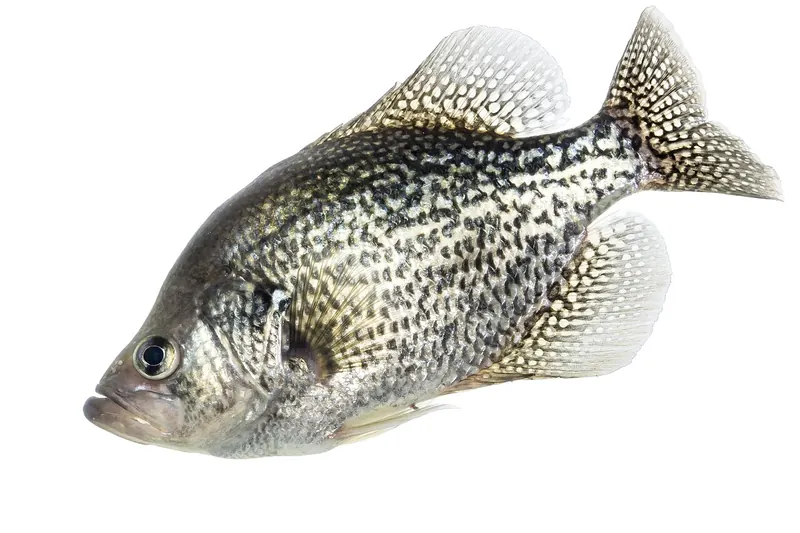
Photo: USFWS Mountain Prairie, Wikimedia Commons, Public domain, adjusted to 3:2
- Spawning
- Spring to early summer at 58 to 68 °F (14 to 20 °C); the male sweeps a nest in sand or mud in 1 to 6 ft of water, usually near wood or vegetation, and guards it until the eggs hatch (Wikipedia; general guide, varies by region)
- Typical method
- Small jigs, with or without a bobber
- Top bait
- Live minnow
How to recognise it
- Deep, strongly flattened body, silvery gray to greenish with irregular black blotches
- Big mouth reaching below the eye, thin lips
- Dorsal and anal fins nearly the same size and spotted; 7 or 8 spines in the dorsal fin
Easily confused with: The white crappie (Pomoxis annularis) has only 5 or 6 dorsal spines, 5 to 10 dark vertical bars instead of scattered blotches and a slightly longer body; it outnumbers the black crappie in murky water (Wikipedia, TPWD). True sunfish such as the bluegill have a much smaller mouth.
How to catch it
Methods: Small jigs, with or without a bobber, Live minnow under a bobber, Spider rigging: several long rods from the boat, Trolling small crankbaits
Baits: Live minnow, Small soft plastic jig, Small crankbait
Spring, when fish move shallow to spawn; otherwise around sunken trees, docks and other cover. According to Wikipedia crappie feed mostly early in the morning and around midnight.
Habitat and food
Probably native to the eastern United States and Canada, and stocked into all 48 contiguous states. Lives in lakes, reservoirs, ponds and quiet stretches of large rivers; prefers clear water with little current, plenty of cover such as sunken timber or vegetation, and a sand or mud bottom (Wikipedia).
Young fish eat plankton and tiny crustaceans, larger ones increasingly small fish such as shad and minnows. Adult black crappie eat fewer fish and more insects and crustaceans than white crappie (Wikipedia, TPWD).
Size and age
Usually 4 to 8 in (10 to 20 cm) (Wikipedia). Maximum reported length 49 cm (19.3 in), maximum weight just under 2.7 kg (6 lb), IGFA all-tackle world record 2.47 kg (5 lb 7 oz). The white crappie record is 2.35 kg (5.2 lb) from Enid Dam, Mississippi, 1957 (Wikipedia). FishBase: max. 49 cm, maximum published weight 2.7 kg, maximum age 15 years.
Protection and rules
We found no minimum size or closed season for this species in any state fisheries regulation. Local water rules may still apply.
Closed seasons and minimum sizes are set by each German state and can be stricter for single waters. All rules by state, with the legal source
In the kitchen
According to TPWD crappie (black and white combined) is the most popular panfish in Texas; in Louisiana it is called sac-a-lait (Wikipedia).
Sources (6)
- de.wikipedia.org/wiki/Schwarzflecken-Sonnenbarsch
- en.wikipedia.org/wiki/Black_crappie
- en.wikipedia.org/wiki/White_crappie
- fishbase.se/summary/Pomoxis-nigromaculatus.html
- tpwd.texas.gov/huntwild/wild/species/crappie/
- tpwd.texas.gov/huntwild/wild/species/wcp/
Last checked 2026-10-15. Found a mistake? Write to [email protected].
Know more?
Additions, photos of your catches or a mistake in the text: write to us and we will gladly credit you as a helper.
Send a tip