Species
Bluegill
The classic first fish for young U.S. anglers: a small, deep-bodied sunfish with a bluish chin, a solid black ear flap and often an orange breast.
Lepomis macrochirus
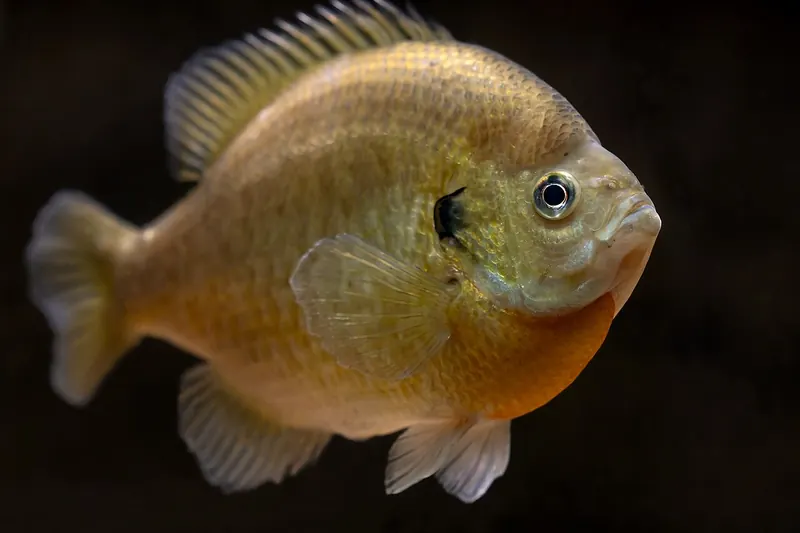
Photo: USFWS Mountain Prairie, Wikimedia Commons, Public domain, adjusted to 3:2
- Spawning
- Late May to August, peaking in June at 67 to 80 °F (19 to 27 °C); males fan out spawning beds in gravel or sand in shallow water, packed close together, and defend them fiercely (Wikipedia; general guide, varies by region)
- Typical method
- Bobber fishing with live bait near the bank
- Top bait
- Worm
How to recognise it
- Deep, flattened body with a small mouth
- Solid black ear flap with no colored edge, blue on the sides of the head and chin
- Dark blotch at the rear of the dorsal fin, 5 to 9 dark vertical bars; yellowish breast, bright orange in spawning males
Easily confused with: The pumpkinseed has a black ear flap with an orange edge. The redear and orangespotted sunfish are close relatives but lack the dark blotch at the rear of the dorsal fin (Wikipedia). Hybrids with other Lepomis species occur, most often with the green sunfish.
How to catch it
Methods: Bobber fishing with live bait near the bank, Ultralight spinning with tiny spinners and soft plastics, Fly fishing with small poppers
Baits: Worm, Cricket, Maggot, Grasshopper, Small spinner, Small soft plastic
During the spawn from May to August, when males attack anything near the nest; during the day mainly mornings and evenings around weeds and wood (Wikipedia).
Habitat and food
Native east of the Rocky Mountains from Virginia to Florida, west to Texas and northern Mexico, north to Minnesota, New York and southern Ontario; introduced worldwide. Lives in ponds, lakes, creeks and slow rivers with lots of vegetation and cover such as stumps and fallen logs; tolerates brackish water up to 1.8 % salinity (Wikipedia).
Omnivore: mainly aquatic insect larvae such as mayflies, caddisflies and dragonflies, plus land insects, zooplankton, crustaceans, leeches, snails and small fish; when food is scarce also plants and algae (Wikipedia).
Size and age
Usually 4 to 12 in (10 to 30 cm), maximum just over 16 in (41 cm). IGFA all-tackle world record 4 lb 12 oz (2.15 kg) from Ketona Lake, Alabama, 1950 (Wikipedia). FishBase: max. 41 cm, maximum published weight 2.2 kg, maximum age 10 years; Wikipedia says up to 11 years in extreme cases.
Protection and rules
We found no minimum size or closed season for this species in any state fisheries regulation. Local water rules may still apply.
Closed seasons and minimum sizes are set by each German state and can be stricter for single waters. All rules by state, with the legal source
In the kitchen
Because of its size and the way it is cooked, it is the classic American panfish (Wikipedia).
Sources (4)
- de.wikipedia.org/wiki/Blauer_Sonnenbarsch
- en.wikipedia.org/wiki/Bluegill
- fishbase.se/summary/Lepomis-macrochirus.html
- tpwd.texas.gov/huntwild/wild/species/bgl/
Last checked 2026-10-15. Found a mistake? Write to [email protected].
Know more?
Additions, photos of your catches or a mistake in the text: write to us and we will gladly credit you as a helper.
Send a tip