Species
Ide
A strong, shy whitefish of the large lowland rivers that also enters the brackish Baltic Sea; large ides feed mainly on fish.
Leuciscus idus
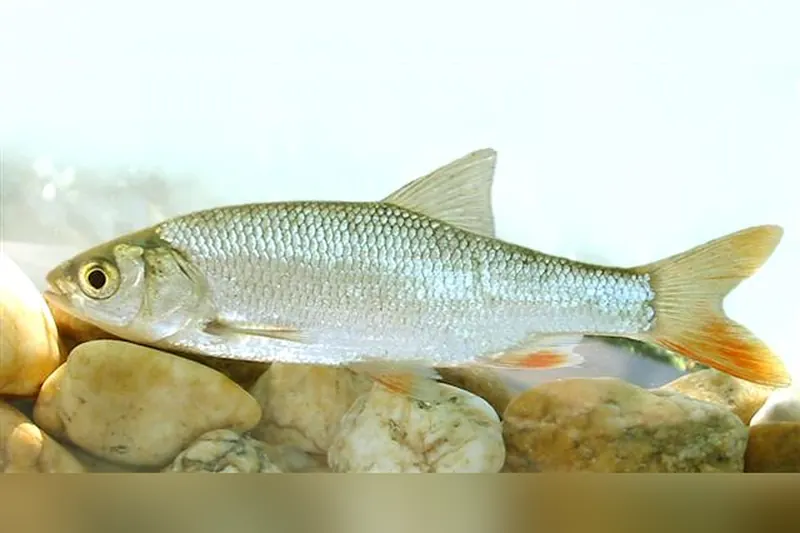
Photo: Harka, Akos, Wikimedia Commons, CC BY 3.0, adjusted to 3:2
- Spawning
- April to June depending on water temperature, after a spawning migration in spring to calmer river sections (general guide, varies by region)
- German Red List
- not threatened
- Typical method
- Float fishing in mid-water
- Top bait
- White bread flake
How to recognise it
- Elongated, laterally flattened body with a terminal mouth
- Small scales, 56 to 58 along the lateral line (FishBase)
- Grey-bluish back, silver flanks, fins with a reddish sheen, anal fin curved inwards
Easily confused with: Looks very much like the chub, but has smaller scales and an anal fin that curves inwards. The terminal mouth and much smaller scales set it apart from the rudd. The golden ornamental form is called the golden orfe.
How to catch it
Methods: Float fishing in mid-water, Feeder fishing, Lure fishing (spinning) with small lures, Fly fishing
Baits: White bread flake, Maggots, Worm, Small spinner
In the warm summer months; large ides then like to hold under overhanging trees and wait for drifting food. They are considered very shy and cautious.
Habitat and food
Lower reaches of slow-flowing lowland rivers such as the Rhine, Weser, Elbe, Oder and Vistula, nutrient-rich lakes and the brackish water of the Baltic coast; of all whitefish it is the least sensitive to salt. In smaller rivers, large ides like to hold under overhanging trees and bushes.
Young fish eat zooplankton, later insect larvae, snails, mussels and smaller fish; FishBase adds plant material and states that larger ides feed mainly on fish.
Size and age
On average 30 to 50 cm and 0.25 to 2 kg; maximum known figures are 80 cm and 6 kg, and the German record fish weighed 4 kg (Rhine, 2000). Lifespan in the wild up to 18 years (Wikipedia). FishBase: max. 85 cm (standard length), heaviest published weight 4.0 kg, maximum age 29 years. The sources differ on weight.
Protection and rules
Ide: closed season and minimum size by German state
- Baden-Württembergminimum size 25 cm · closed season 01.04. to 31.05.
- Bavariaminimum size 30 cm · closed season 01.03. to 30.04.
- Berlinminimum size 30 cm
- Brandenburgminimum size 30 cm
- Mecklenburg-Western Pomeraniaminimum size 25 cm
- North Rhine-Westphaliaminimum size 25 cm
- Rhineland-Palatinateprotected all year
- Saxonyminimum size 20 cm
- Thuringiaprotected all year
From the official state fisheries regulations, retrieved 2026-10-11. All rules by state
Closed seasons and minimum sizes are set by each German state and can be stricter for single waters. All rules by state, with the legal source
In the kitchen
FishBase describes the flesh as not tasty; in Eastern Europe, however, the ide is regarded as a good food fish and is also caught commercially along the Danube (English Wikipedia).
Sources (4)
- de.wikipedia.org/wiki/Aland_(Fisch)
- fishbase.se/summary/Leuciscus-idus.html
- rote-liste-zentrum.de/detail/pdf/91237
- en.wikipedia.org/wiki/Ide_(fish)
Last checked 2026-10-13. Found a mistake? Write to [email protected].
Know more?
Additions, photos of your catches or a mistake in the text: write to us and we will gladly credit you as a helper.
Send a tip